
5 Essential Skills for Jamming with Other Musicians
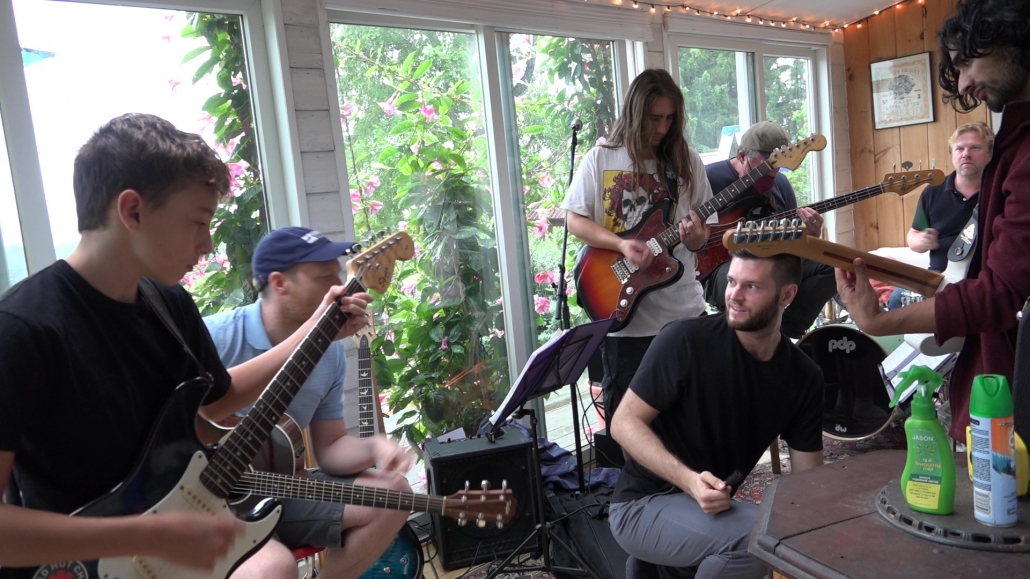
/by Dennis WingeRecently, while leading a student jam session, I was reminded of something I’ve noticed many times over my years of teaching guitar. There are plenty of guitarists who have reached what we might call the early-intermediate level: they can change chords in time, know their barre chords, have learned a pentatonic scale or two, and can play quite a few songs. Yet when they get together with other musicians, they often discover that there is a whole other set of skills they haven’t really worked on.
This is perfectly understandable. Most guitarists spend a great deal of time learning songs, chords, scales, techniques, and perhaps some music theory. These are all important, but they don’t necessarily prepare you for the experience of playing with other people, where you’re constantly making decisions based on what you’re hearing. Something that sounds great when you’re playing alone might not work nearly as well when three or four other musicians are playing at the same time.
The good news is that becoming a better ensemble player doesn’t necessarily mean learning a hundred more chords or memorizing another dozen scales. It often means developing a greater awareness of what you’re already playing and learning how to use your existing skills in more musical ways. Here are five areas that I believe deserve considerably more attention from guitarists who want to become better at jamming with others.
1. Listening
It might seem obvious that listening is an essential part of playing music, but there’s a big difference between hearing the other musicians and actively listening to what they’re doing. Many guitarists are so focused on playing their own part correctly that they have very little attention left for anyone else. They may be playing the right chords at the right time, but they aren’t necessarily contributing to the overall musical conversation.
For example, suppose you’re playing rhythm guitar while someone else is soloing. Are you aware of when the soloist is playing a busy phrase versus a sparse one? Are you listening to the drummer’s accents and the bass player’s rhythmic patterns, if your group has a drummer and bassist? Are you aware of what the other rhythm guitarists are doing, if there are any? Or are you simply strumming away using the same pattern you would have played if you were the only guitarist in the room?
But even when guitarists become aware that they should listen more carefully, they may not have the rhythmic or harmonic vocabulary to do much with what they hear. If another guitarist is already playing a full six-string G chord, for example, what alternatives do you have? You could play a triad voicing, add a complementary rhythmic figure, play a muted line, or perhaps not play anything at all for a few beats.
To make those choices, you need to know something about different chord voicings, rhythmic subdivisions, and how various parts can fit together. In other words, better listening is only part of the solution. You also need the musical vocabulary to respond to what you’re hearing, and that takes knowledge and practice.
This applies to the soloist as well. A good accompanist might leave additional space during a delicate passage, provide more rhythmic support as the solo builds, or respond to or prompt the soloist with some kind of rhythmic or harmonic idea. The goal isn’t to react to every single note the soloist plays, but to be aware of the direction the music is taking and help it get there, or even suggest where it might go.
Exercise
The next time you jam, spend an entire chorus concentrating on what everyone else is playing instead of thinking primarily about your own part. Try simplifying your accompaniment as much as possible so that you have more attention available for listening. Then ask yourself what you could contribute that would complement the other players rather than duplicate what they’re already doing.
You might discover that the most musical contribution you can make is much simpler than what you were originally playing. Begin by listening to the whole ensemble as a musical conversation rather than focusing exclusively on your individual part. That’s a very different way of approaching rhythm guitar from simply asking, “What strumming pattern should I use?”
2. Tempo and Time Signatures
Another thing I’ve noticed is that many early-intermediate guitarists have a surprisingly narrow range of tempos at which they feel comfortable playing. They might do very well with a medium-tempo rock or folk song, but ask them to play considerably faster or slower and things begin to fall apart. Inexperienced guitarists will often unconsciously pull the music back toward the tempo at which they’re most comfortable.
There are different reasons for this depending on whether the tempo is fast or slow. At faster tempos, physical technique becomes a limiting factor: the picking or strumming hand may not be efficient enough to execute the required rhythms cleanly. At slower tempos, the challenge is often more a lack of rhythmic versatility than sheer technique, because there is so much space between the beats that the player has difficulty maintaining a steady internal pulse.
In some ways, playing slowly can be harder than playing quickly. At a comfortable medium tempo, your hands might be able to operate almost automatically, but at a very slow tempo you have to become much more aware of the subdivisions between the beats. If you’re not feeling those subdivisions internally, it’s easy to rush ahead or become uncertain about where the next beat belongs.
A related problem is familiarity with different time signatures. Most guitarists spend the vast majority of their playing time in 4/4, and some are comfortable in 3/4 as well. But what about 6/8, 12/8, 6/4, or 5/4? These aren’t simply mathematical variations on 4/4; they can involve different ways of grouping the beats and feeling the pulse.
For example, 3/4 and 6/8 both contain six eighth notes per measure, but the way those notes are grouped is typically different. In 3/4, we generally feel three quarter-note beats per measure, while in 6/8, we commonly feel two dotted-quarter-note beats, each containing three eighth notes. Understanding that intellectually is one thing; being able to play naturally in either meter without losing the underlying feel is another.
Exercise
Take a simple progression such as G–C–D–G and practice it with a metronome at several different tempos, including tempos that feel uncomfortably slow or fast. Rather than immediately increasing the tempo when something feels awkward, spend some time figuring out why it’s difficult. You may discover that you need to work on your strumming technique, internal subdivision, or simply your ability to stay mentally engaged with a slower pulse.
Then try playing the same progression in 3/4, 6/8, and 12/8, being careful to feel the characteristic pulse of each meter rather than just counting the required number of notes. Eventually, you could experiment with 5/4, grouping its five quarter-note beats as either 2+3 or 3+2. The idea isn’t to master every possible time signature overnight, but to gradually expand the range of rhythmic situations in which you feel comfortable.
3. Rhythmic Vocabulary
This is an area that I think gets overlooked in guitar education. A student might spend months learning new chords and scales while continuing to use essentially the same two or three strumming patterns for almost everything they play. As long as the pattern fits the song reasonably well, there may not seem to be any particular reason to change it.
But imagine what happens when several guitarists who have this approach begin playing together. Each one might be playing a perfectly acceptable part on their own, but when those parts are combined, the result can become monotonous or cluttered. They may be playing the same chords in the same register, using nearly identical rhythmic patterns, without recognizing that a different approach might sound better.
The solution isn’t necessarily to make each part more complicated. Sometimes it’s a matter of playing fewer notes, choosing smaller chord voicings, or emphasizing different parts of the beat. The important thing is to have enough rhythmic vocabulary to make these choices rather than relying on the same familiar patterns in every situation.
I explored this subject in a Friday Rhythm Games video called Interlocking Rhythms, which demonstrates how two or more guitar parts can complement each other rather than simply duplicate what everyone else is playing. In the accompanying Interlocking Rhythms article, I take this considerably further, beginning with common strumming and shuffle patterns and eventually exploring some of the fascinating interlocking rhythms found in Afro-Cuban music. The examples demonstrate how rhythmic precision, chord voicings, and awareness of the other parts can transform even a simple chord progression into something much more interesting. The article includes written examples and audio demonstrations for anyone who wants to explore these ideas in greater depth.
Exercise
Get together with another guitarist and choose a simple two-chord progression. Have one player establish a repeating rhythm while the other experiments with playing in the spaces between the first player’s attacks. Once that becomes comfortable, try changing roles, using smaller chord voicings, and creating patterns that occasionally coincide rather than always staying separate. The goal isn’t to avoid playing on the same beats altogether, but to become more conscious of how the different parts interact.
You can also do this exercise by yourself using a looper or recording software. Record a simple rhythm guitar part, then overdub another part that complements it without duplicating it. In addition to improving your rhythmic awareness, this will teach you a great deal about arranging music and how much more interesting two simple parts can sound when they’re designed to work together.
4. Volume Control
One of the most noticeable problems in a group jam is when players don’t manage their volume appropriately. Electric guitarists, in particular, can easily overpower the acoustic players sitting next to them, often without realizing they’re doing so. And when someone turns up for a solo, they sometimes forget to bring the volume back down afterward.
I’ve also noticed that when I ask an electric guitarist to turn down, the first instinct is usually to reach for the volume knob on the guitar. That might solve the problem temporarily, but before long the volume often creeps back up again. A better starting point is to set the amplifier at a volume that is appropriate for the room and the other musicians, rather than relying entirely on the guitar’s volume control to maintain a reasonable level.
But there is a much more fundamental skill involved here. One of the things I was taught early on is that your volume control is in your pick, not in a knob. In other words, a guitarist should be able to play softly or loudly by changing the attack of the picking or strumming hand, without having to make an electronic adjustment every time the dynamics change.
This is especially important when accompanying another musician. If someone is soloing, your job is generally to stay underneath them dynamically so their musical ideas can be heard clearly. When it’s your turn to solo, you can increase your volume, ideally through your picking attack when possible, but afterward you need to return to an appropriate accompaniment level.
The same principle applies within individual phrases. You might begin a phrase softly, gradually increase your intensity, emphasize a particular note, and then let the phrase settle back down. These kinds of dynamic variations are part of what makes music expressive, and they should become as natural as changing chords or playing different rhythms.
Of course, there are legitimate musical reasons to use a guitar’s volume knob, an amplifier, or a boost pedal. But those tools shouldn’t replace the ability to control dynamics through your hands. The more control you have over your picking attack, the more responsive your playing can become.
Recently, at a Guided Guitar Jam I was leading at the North Myrtle Beach library, we encountered a perfect example of this. We had seven guitarists playing chords to accompany a single acoustic guitarist who was soloing. I calmly pointed out how difficult it could be for seven rhythm guitarists to play together without overpowering one soloist. Just making everyone aware of the situation was enough to change the dynamics, and suddenly we could hear the soloist perfectly!
I complimented the group on the fact that 42 strings could collectively stay quieter than the single string being played at any given moment by the soloist. When I asked how they had accomplished this, one of the responses was simply, “I just held the pick lighter.” That was all it took! No one had to change their chord voicings, stop playing, or adjust any electronic equipment. They simply became more aware of how much volume they were producing and made the necessary adjustments with their hands.
There’s another aspect of this subject that I explored in my Ultimate Guitar article, How to Balance the Volume Between Lead and Rhythm Guitar. Strummed chords naturally produce a fuller sound than single-note lines, and this can lead guitarists to turn up their overall volume to compensate when soloing. The article explores how developing greater control over the contrast between rhythm and lead playing can improve your dynamics, your ability to accompany others, and even how relaxed you feel while playing.
Exercise
Choose a simple chord progression and play it repeatedly without touching your volume controls. Start as softly as possible while still producing a clear sound, gradually build to a strong strum, and then return to the original soft volume. Try making these changes over four-bar or eight-bar phrases rather than changing volume randomly.
Then practice this with another musician, taking turns playing lead and accompaniment. See whether you can establish an appropriate balance using your hands alone, with the accompanist remaining quieter than the soloist. This exercise can be surprisingly revealing, especially if you’re accustomed to playing at one basic dynamic level all the time.
5. Phrasing
Many guitarists reach the early-intermediate stage knowing one or two pentatonic scale patterns and perhaps a collection of licks they’ve learned. These are useful tools, but knowing where the notes are doesn’t automatically mean you know how to put them together into meaningful musical statements. Just as knowing a collection of words doesn’t necessarily make someone a good conversationalist, knowing a scale doesn’t necessarily make someone a good improviser.
The first things I notice when listening to a guitarist’s solo are their tone and feel. After that, I pay attention to their phrasing. Are they leaving space between phrases? Some guitarists seem to feel that once their solo begins, they have to keep playing until it’s over, filling every available moment with notes. But silence is an important part of phrasing, and allowing a musical idea to breathe can make it far more effective than filling every space with another lick.
Another important ingredient is the use of motifs, which are short musical ideas that can be repeated and developed. Instead of playing one unrelated lick after another, a guitarist might introduce a simple three- or four-note phrase and then repeat it with a different rhythm, change the ending, move it to another register, or adapt it to the next chord. This gives the listener something recognizable to follow and helps create a sense of continuity.
Phrasing is so important because two phrases using exactly the same notes can sound completely different depending on where they begin, which notes are accented, how long the notes are sustained, and where the silences occur. Syncopation, changes in rhythmic density, and variations in phrase length all contribute to making a solo more expressive and less predictable.
Other ingredients include melodic contour, articulation, dynamics, tension and release, embellishments, and harmonic awareness. A phrase might rise gradually in pitch, build in intensity, reach a high note, and then resolve to a chord tone at the end of the progression. Another phrase might consist of just two or three notes, but the placement of those notes and the way they’re articulated can make them extremely effective.
It’s also important to be aware of the form and structure of the song. If you’re playing a twelve-bar blues, for example, do your phrases acknowledge where you are in the progression? Are you aware of when the IV chord arrives, when the turnaround approaches, and how you might shape your solo over several choruses rather than treating every measure as an isolated opportunity to play something?
In a song with an AABA form, you might develop a musical idea through the first two A sections, introduce a contrasting idea during the bridge, and then return to the original idea in the final A section. You don’t have to plan every note in advance, but being aware of the larger structure gives your improvisation a sense of direction. The difference is similar to telling a story with a beginning, middle, and end rather than simply saying whatever happens to come to mind.
Phrasing isn’t limited to soloing, either. Rhythm guitarists need to recognize where musical phrases begin and end, where the song is building toward a new section, and when the accompaniment should become busier or more sparse. A rhythm guitarist who understands phrasing is much better equipped to support a singer or soloist because they’re aware of the larger musical picture.
Exercise
Put on a backing track or play with another musician and limit yourself to just three or four notes from a pentatonic scale. Create a short phrase, leave some space, and then answer that phrase with something related to it. For example, you might repeat the same rhythm with a different ending, or play the same notes but begin on a different part of the beat.
Next, try playing a two-bar phrase followed by two bars of silence, then develop your original phrase when you come back in. Resist the temptation to introduce an entirely new idea every time you start playing again. By limiting your note choices and focusing on rhythm, space, and development, you may find that your solos begin to sound more musical even though you’re actually playing fewer notes.
Putting It All Together
One of the most interesting things about these five areas is how closely related they are. Listening helps you recognize what the ensemble needs, but rhythmic and harmonic vocabulary give you the tools to respond. Tempo flexibility allows you to function in different musical situations, while dynamic control and phrasing help you make contributions that are appropriate to the music rather than simply playing whatever you happen to know.
These aren’t skills that only beginners or intermediate guitarists need to develop, either. Experienced professional musicians continue refining their listening, rhythmic awareness, dynamics, and phrasing throughout their careers. It’s also worth pointing out that none of these skills develops simply because you understand the concept. Knowing that you should listen more carefully doesn’t automatically give you the ability to create a complementary rhythm guitar part, just as knowing that you should leave space doesn’t automatically make your solo phrasing more interesting. You have to practice these things deliberately, ideally both on your own and with other musicians, until they become second nature.
For guitarists who are already comfortable changing chords, playing barre chords, and using some basic scales, I would encourage devoting at least as much attention to these five areas as to learning more technical material. That doesn’t mean abandoning the study of new chords, scales, or techniques. It means recognizing that musical growth involves not only expanding what you’re capable of playing, but also developing the awareness and judgment to know what, when, how, and even whether to play.
The next time you’re at a jam session, try thinking a little less about whether you’re playing the right notes and a little more about how your playing relates to everything else that’s happening. Are you listening? Are you contributing something rhythmically and harmonically useful? Are you leaving room for other musicians to express themselves?
After all, there’s a big difference between knowing how to play the guitar and knowing how to make music with other people. Learning to bridge that gap can be one of the most rewarding parts of becoming a better musician.
Book a free trial lesson, available both in-person and online. Fill out this form and we’ll respond within 24 hours.
