
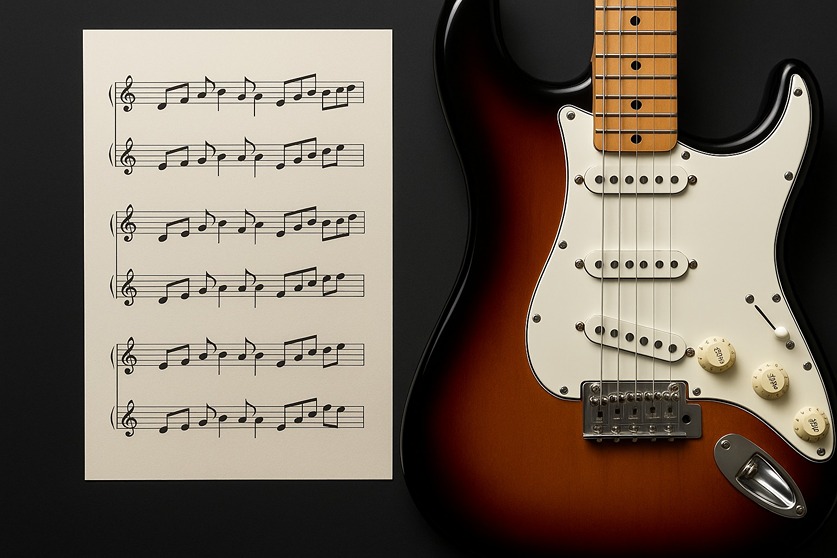
The Amazing Potential of Melodic Motifs
/by Dennis WingeWhen we think about motifs in music, we often imagine a catchy little idea that repeats — Beethoven’s famous “da-da-da-DAA” comes to mind instantly. But motifs don’t have to be long or complicated to be powerful. In fact, the tiniest cells can sometimes yield the richest results.
This post is the first in a multi-part series on motifs. We’ll start with melodic motifs, the building blocks of melody itself. Later posts will cover rhythmic, technical, and harmonic motifs. For now, let’s dive into the melodic side and explore how even two notes can open the door to endless creativity.
The Simplest Motif: Seconds
The most basic melodic motif you can play is just two notes a step apart — what musicians call a second. In the key of A major, that could be a–b, b–c#, c#–d, and so on.
One exercise I use with students is to take an ascending second up and back through the scale:
-
a–b–a
-
b–c#–b
-
c#–d–c#
-
d–e–d
-
e–f#–e
-
f#–g#–f#
-
g#–a–g#
Then we do the same with descending seconds:
-
a–g#–a
-
b–a–b
-
c#–b–c#
-
d–c#–d
-
e–d–e
-
f#–e–f#
-
g#–f#–g#
At first glance, this may seem almost too simple. But simplicity is exactly the point.
Improvising with Only Seconds
Once students are comfortable with fixed patterns, we move into improvisation. The first step is to improvise using only seconds.
Here’s how it works:
-
Pick a groove in A major.
-
Restrict yourself to only ascending or descending seconds.
-
Use any rhythm you like.
For example:
-
Play a–b–a as eighth notes, then c#–d–c# as quarter notes.
-
Throw in f#–g#–f# as a triplet, then e–f#–e syncopated across the bar.
This restriction might feel limiting, but it’s actually liberating. It forces you to dig deep into rhythmic variation, articulation, and feel.
Why This Matters
-
Bridges technique and creativity: You’re not just drilling — you’re making music.
-
Groove awareness: Seconds become rhythmic shapes, not just notes.
-
Motivic improvisation: The ear recognizes the repeated idea, which makes the solo coherent.
-
Confidence in limitation: Fewer notes means more focus on expression.
-
Ear training: Seconds are everywhere in melodies. Practicing them helps you internalize the sound of small steps.
-
Technique: The quick motion back and forth is great for finger independence.
-
Motivic thinking: You learn how to generate a whole passage out of a tiny idea.
-
Improvisation prep: Seconds show up constantly in solos — sometimes as passing tones, sometimes as motifs in their own right.
Seconds as Themes Within the Scale
The next step is to let seconds become themes while opening the door to other notes. In other words, you’re free to improvise with the whole A major scale, but you keep returning to seconds as anchors.
Example:
-
Start with a–b–a, then move up the scale with a run to f#.
-
Drop in b–c#–b as a rhythmic punch.
-
Add a leap to high a, then return to d–e–d for grounding.
This shows students that motifs aren’t about limitation — they’re about organization. The seconds give the solo a spine. Everything else revolves around them.
The Power of Simplicity
I once attended a masterclass by saxophonist Bob [his last name escapes me], and he spent more than half an hour exploring nothing but two-note seconds. He never ran out of variations! He used different rhythms, articulations, dynamics, and phrasings, revealing just how deep the simplest motif can go.
That experience taught me a huge lesson: creativity isn’t about adding more, it’s about digging deeper into what you already have.
Pedal Point Motifs
Another powerful melodic device is the pedal point motif, where one note acts as an anchor while alternating with others.
In A major, you might play:
-
a–b–a
-
a–c#–a
-
a–d–a
-
a–e–a
Or descending:
-
g#–a–g#
-
f#–a–f#
-
e–a–e
-
d–a–d
The pedal (in this case, a) grounds the motif while the other notes orbit around it.
Why It’s Useful
-
Stability vs movement: The pedal provides a home base.
-
Ear training: You hear how each note of the scale relates to the pedal.
-
Improvisational glue: Pedal patterns make solos feel grounded.
-
Fingerboard familiarity: Every interval against the pedal becomes clear.
Variations
-
Reverse the order: b–a–b instead of a–b–a.
-
Use rhythm: syncopate the pedal, or put it on off-beats.
-
Different pedals: use e (the 5th) or c# (the 3rd).
-
Expand to dyads: pedal two notes like a–e together.
Songs that Use Pedal Point in Melody
Pedal points aren’t just exercises — they’re everywhere in music.
-
Thunderstruck (AC/DC) – the famous intro alternates fretted notes on the g string with the open b string.
-
Clocks (Coldplay) – the piano riff constantly returns to a high e.
-
So What (Miles Davis) – the bass riff centers on a repeated d anchor.
-
Irish/Scottish fiddle tunes – often drone a high string while weaving around it.
When the pedal point is used in the melody itself, it becomes a hook — instantly memorable and singable.
Pedals on Any Scale Degree
At first, most players pedal on the root (1) or the fifth (5). But you can use any note in the scale as your pedal.
In A major:
-
Pedal on 3: c#–b–c#, c#–e–c#, c#–f#–c#
-
Pedal on 7: g#–a–g#, g#–f#–g#, g#–d–g#
-
Pedal on 4: d–e–d, d–c#–d, d–a–d
And the fun really begins when you think about movement around the pedal:
-
Close-to-far: start with neighbors, then widen out.
-
Far-to-close: begin with big leaps, then tighten the orbit.
-
Symmetry: equal above/below.
-
Asymmetry: hang mostly on one side.
This transforms the pedal from a static exercise into a storytelling device.
Intervallic Motifs
Beyond seconds, you can build motifs from other intervals:
-
3rds: a–c#–a, b–d–b, c#–e–c#
-
4ths: a–d–a, b–e–b
-
5ths: a–e–a, d–a–d
Each interval creates a different emotional quality. 3rds sound melodic, 4ths sound open, 5ths sound powerful. Sequencing these through the scale gives you strong, recognizable shapes.
Arpeggiated Motifs
Arpeggios are just chords broken into melodic form, but they make excellent motifs. Instead of playing a full scale, you can outline A major with:
-
a–c#–e–a (A major arpeggio)
-
b–d–f#–b (B minor arpeggio)
These motifs tie melody directly to harmony. Classic riffs like the intro to Sweet Child O’ Mine (Guns N’ Roses) are built on this idea.
Repetition and Sequences
Another family of melodic motifs comes from repetition:
-
Repetitive cells: The same figure repeated verbatim (Ravel’s Boléro, Cream’s Sunshine of Your Love).
-
Sequences: The same motif shifted to different starting notes (Baroque composers loved this, but it’s also everywhere in jazz solos).
Repetition builds intensity, and sequences create the sense of climbing or descending through space.
Contrasting Direction Motifs
Sometimes the simplest way to generate interest is to alternate direction:
-
Up then down (a–b–a, c#–d–c#).
-
Down then up (e–d–e, c#–b–c#).
This zig-zagging contour makes motifs conversational, like question-and-answer phrases.
Motifs of Repeated Notes
Even repeating the same note can be a motif. Think of Beethoven’s Ode to Joy, which opens with four repeated notes before moving on. On guitar, this might be playing a–a–a before resolving to b or g#. Repeated notes create insistence and focus.
Ornamented Motifs
In blues, jazz, and folk styles, motifs often come decorated with slides, bends, hammer-ons, pull-offs, or grace notes. These aren’t “extra” — they are the motif. An a–c#–a figure feels completely different if you hammer-on from a to c# instead of picking both notes.
Harmonically-Aware Melodic Motifs
So far we’ve looked at motifs in a single scale or key. But motifs also interact with harmony in powerful ways.
Same Motif, Different Chord
Take one shape and move it with the chords.
-
On A: a–e (1–5).
-
On D: d–a (1–5).
-
On E: e–b (1–5).
The shape is the same, but it adapts to the harmony.
Common-Tone Motifs
Find a note that two chords share and highlight it.
-
c# works as the 3rd of Amaj7 and the 7th of Dmaj7.
-
Holding or repeating it across the change creates smooth continuity.
Adapted Motifs
Keep the contour but shift notes to fit the chord.
-
On Amaj7: a–e (root–5).
-
On Dmaj7: a–f# (5–3).
-
On E7: g#–e (3–root).
The listener hears the same “idea” carried across the progression, even though the pitches change.
These approaches are especially powerful in improvisation — they keep a solo sounding cohesive while still moving with the harmony.
Conclusion
Motifs are the DNA of melody. They can be tiny (a two-note second), anchored (pedal point), intervallic (3rds, 4ths, 5ths), repetitive, sequential, ornamental, or harmonically adaptive. Each approach offers a way to create coherence, storytelling, and identity in your music.
The key is not how many notes you use, but how deeply you can explore a simple idea. As that saxophone masterclass showed me years ago, you can spend half an hour — or a lifetime — discovering new possibilities in the smallest motif.
This is just Part 1 of the motif series. In future posts we’ll look at rhythmic motifs, technical/textural motifs, and harmonic/formal motifs, each with their own creative worlds to explore. For now, try out some of these melodic motif exercises, improvise with them, and start listening for them in the music you love. Chances are, motifs are already doing more work than you realize.
Book a free trial lesson, available both in-person and online. Fill out this form and we’ll respond within 24 hours.
