
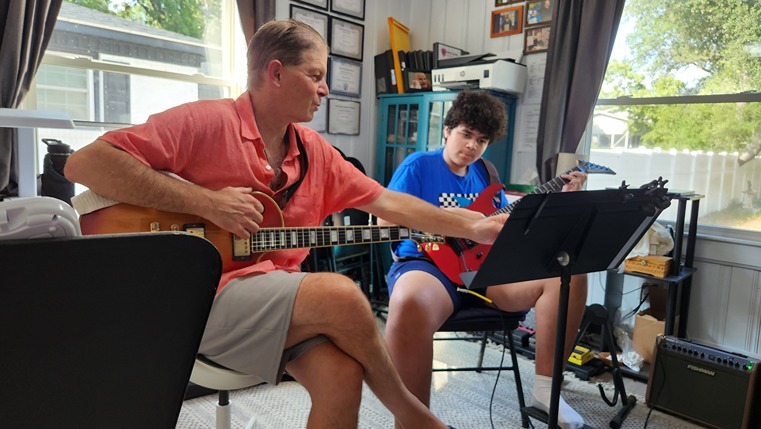
When Teachers and Students Don’t See Eye to Eye
/by Dennis WingeOne of the interesting things about being both a teacher and a student is that you get to experience the learning process from both sides. I’ve been teaching guitar for over 25 years, but I also continue to take lessons myself because I know that there’s always more to learn, no matter how long you’ve been playing. Recently, three experiences happened within the same week that made me think more deeply about the importance of communication, trust, and the delicate balance between giving students direction and allowing them to discover things for themselves.
When a Teacher Challenges Your Approach
I’ve been studying with a wonderful teacher for quite some time, and our lessons have opened up many new musical possibilities for me. One day, he pointed out that my improvisations could use more syncopated sixteenth-note rhythms and gave me some examples to explore. Being the analytical type, I decided to investigate all the possible rhythmic combinations so I could practice them systematically without overlooking anything.
I spent time creating an elaborate document that organized these combinations into a methodical practice system. I was rather proud of it, and I sent it to my teacher thinking he would appreciate my thoroughness and dedication. Instead, at our next lesson, he essentially told me that too much empirical information can get in the way of learning to play jazz.
He wasn’t particularly gentle about it, either. He questioned who would have the time or inclination to work through so many permutations, and some of his comments made me feel rather foolish for having done all that work. I became defensive and resentful, and for the first time in our relationship, I actually wondered whether I wanted to continue studying with him.
But here’s the interesting part: at our next lesson, he asked me to demonstrate some of the sixteenth-note rhythms I’d been practicing. When I told him that certain combinations were still difficult, he showed me an entirely different way to practice and apply the material. Within minutes, we were making considerably more musical progress than I had made through all my systematic analysis!
Suddenly, I understood what he had been trying to tell me. My document wasn’t necessarily worthless, and some of the combinations I’d discovered might still be useful, but I had become so preoccupied with cataloging rhythmic possibilities that I’d lost sight of the real objective: being able to use those rhythms spontaneously and creatively in music. My teacher had enough experience to recognize something I couldn’t see for myself.
Nevertheless, I still think there’s an important distinction between challenging a student’s approach and making the student feel that their effort was foolish. A teacher may be absolutely right about the musical direction while being less effective in communicating it. In my case, the lesson eventually proved invaluable, but the resentment I experienced could easily have interfered with my willingness to receive it.
The Shoe Was Suddenly on the Other Foot
Almost immediately afterward, one of my beginning guitar students arrived with an interesting project of his own. He was playing some relatively simple songs with a group and wanted to make them more sophisticated by adding chord embellishments. He had prepared an extensive list of variations such as sus2, sus4, sixth chords, and other possibilities for practically every chord in the songs.
My first reaction was that he was getting way ahead of himself. He was still struggling to change between basic chords smoothly, maintain a consistent strumming pattern, and stay in time with the music. Adding a long list of sophisticated chord variations wasn’t going to solve those problems, and might actually make them worse by diverting his attention from the fundamentals.
Then it hit me: this was remarkably similar to what had just happened between my teacher and me! Here was a student who had enthusiastically invested time and energy into something that interested him, yet I could immediately see that his efforts weren’t directed toward what he most needed to learn. The difference was that this time I was the teacher who had to redirect the student.
I told him that I appreciated his desire to make the music more interesting and that chord embellishments were certainly worth exploring. However, I explained that developing solid timing and basic strumming skills would serve him much better at his current level, and suggested that we concentrate on those first. Once he could play the songs comfortably and in time, we could return to the embellishments and make them sound musical rather than simply complicated.
He accepted my suggestion, and we moved forward. But the experience made me realize how easily a teacher can unintentionally discourage a student’s enthusiasm, especially when the student has invested considerable effort in something. I’ve probably done that myself on other occasions without even realizing it.
The Student Doesn’t Know What They Don’t Know
One of the primary reasons people take lessons is to benefit from the experience and perspective of someone who has already traveled the road they’re trying to navigate. A good teacher knows which skills are foundational, which difficulties are likely to arise, and which activities will produce the greatest improvement at any given stage. The student, no matter how intelligent or motivated, doesn’t necessarily have that perspective yet.
This is especially important today, when practically unlimited information is available online. Students can find videos, exercises, chord charts, theoretical explanations, and practice systems for virtually any musical subject imaginable. But having access to information isn’t the same as knowing which information is relevant to your current needs or how to organize it into an effective learning process.
Sometimes a student becomes fascinated with a relatively advanced subject while overlooking a much more basic skill that needs attention. There’s nothing wrong with curiosity, of course, and I certainly don’t want to discourage students from exploring music independently. However, part of my responsibility as a teacher is to help them distinguish between what is interesting and what is most useful right now.
That doesn’t mean the teacher is always right, or that students should abandon their own ideas whenever they receive conflicting advice. It means that the teacher has a broader perspective that deserves serious consideration, even when the reasons behind a particular recommendation aren’t immediately obvious. Sometimes, as I discovered with my rhythmic exercises, you have to experience a different approach before you can understand why it’s better.
What Happens When Direction Feels Like Pressure?
The third experience that week introduced another dimension to this subject. I spoke with a prospective student who explained that he experiences something called PDA, or Pathological Demand Avoidance, sometimes described as a Persistent Drive for Autonomy. He told me that he needs considerable freedom to explore things independently and that feeling pressured to perform certain tasks in a prescribed way or time frame can actually interfere with his ability to learn.
I wasn’t particularly familiar with PDA, so I asked the young man to send me a resource he had mentioned called The Safe Circle Coloring Book. It shows how stress, pressure, and a person’s current emotional state can affect their capacity to engage in activities, including things they genuinely want to do. The book uses the metaphor of a circle to illustrate how someone’s sense of safety and capacity can expand or contract depending on their circumstances.
Of course, most of us have experienced days when learning seems effortless and others when even simple tasks feel difficult. For someone who experiences a particularly strong response to demands, however, the language and structure of a lesson may be especially important. An instruction that seems perfectly harmless to the teacher might feel overwhelming or controlling to the student.
This presented an interesting challenge for me because I believe strongly in providing students with structure and consistent guidance. I require a minimum number of lessons per month because I’ve seen what happens when students go too long without feedback. They not infrequently will practice something incorrectly, spend disproportionate amounts of time on relatively unimportant details, or develop habits that become increasingly difficult to correct.
At the same time, I don’t want students to feel that their lessons are another obligation that creates unnecessary pressure in their lives. I explained to this prospective student that I was willing to be flexible and suggested that we establish some kind of signal he could use whenever he needed more space or felt overwhelmed. He also appreciated the fact that I provide written materials and videos between lessons, which allow students to explore the material independently and at their own pace.
This made me think about the distinction between structure and control. Structure provides direction, continuity, and a framework for progress, whereas control can make the student feel that they have little say in the learning process. Ideally, a teacher should be able to provide the former without unnecessarily imposing the latter.
I don’t think of myself as a controlling teacher, but I remember one lesson during the holiday season when I was dealing with a stressful family situation. Without realizing it, I was pushing a student too hard and expecting him to learn too quickly. After almost an hour, he became frustrated and stopped responding. I asked him to come into another room so we could talk, and I listened to his concerns. I also apologized, acknowledging that my family situation might have affected how I was teaching that day. He seemed to accept my apology, but he quit a week or two later. I still regret that I wasn’t more sensitive to what he needed at the time.
A 2025 review of 94 studies found that supporting students’ autonomy and providing clear instructional structure tend to reinforce each other rather than compete. A 2020 study published in the Journal of Research in Music Education, involving 190 music students and 35 teachers, found that autonomy-supportive teaching was associated with greater student well-being, while controlling teaching behaviors were associated with poorer well-being.
Communication Goes Both Ways
Looking back on these experiences, I keep coming back to the importance of trust. Students need to trust that their teachers are making recommendations based on experience and a genuine desire to help them improve. Teachers, in turn, need to respect their students’ curiosity, individuality, emotional responses, and desire to take ownership of their learning.
But trust doesn’t mean blind obedience. A student should feel comfortable asking why a particular exercise is important, expressing frustration, or explaining that an approach doesn’t seem to be working. Similarly, a teacher needs to be able to challenge a student’s assumptions or redirect their efforts without constantly worrying that any disagreement will damage the relationship.
I also realize that communication isn’t always as straightforward as we might hope. My own teacher probably has no idea how upset I was during that particular lesson, just as I may not realize when something I’ve said has discouraged one of my students. If students never express those feelings, their teachers may never have the opportunity to clarify their intentions or make adjustments.
One useful habit might be for teachers to explain not only what they want students to practice, but why they’re recommending it and what they expect it to accomplish. Equally important is making room for students to communicate what they’re experiencing, whether that means confusion, frustration, excitement, or a need for more independence. Sometimes a simple conversation can prevent a relatively minor misunderstanding from becoming a serious obstacle.
Finding the Balance Between Guidance and Independence
There is no single teaching method that works equally well for everyone. Some students want detailed instructions, specific assignments, and plenty of accountability, while others thrive when given broader objectives and the freedom to experiment. Most of us probably need some combination of those approaches, and the balance may change as we develop.
I also think it’s important to recognize that a teacher’s job isn’t simply to give students whatever they want. If someone hires me to help them become a better guitarist, I have a responsibility to point out problems and recommend solutions, even when those recommendations aren’t what the student expected to hear. Otherwise, I’m not really providing the benefit of my experience.
At the same time, the ultimate goal isn’t to make students dependent on their teachers. It’s to help them become increasingly capable of making their own musical decisions, recognizing their own weaknesses, solving problems, and expressing themselves creatively. A good teacher provides guidance not to control the student’s musical journey, but to help the student take greater ownership of it.
That requires flexibility on both sides. Teachers need to recognize that students bring their own ideas, personalities, experiences, and emotional needs into every lesson, while students need to remain open to guidance that may challenge their assumptions. Neither party has all the answers, and both have something to learn from the relationship.
Trust Is Something We Build Together
My experience with the sixteenth-note exercises taught me that even after decades of playing and teaching, I can become so attached to my own approach that I overlook a better one. My experience with the beginning student reminded me that recognizing what someone needs to learn is only half the challenge; communicating it without discouraging their enthusiasm is equally important. And my conversation with the prospective student, along with memories of times when I haven’t handled lessons as well as I could have, made me more aware of how differently students can experience the same teaching environment.
These experiences also helped me recognize an important distinction: a teacher may know what a student needs to work on without necessarily knowing the best way to communicate it to that particular person. Conversely, a student may have perfectly legitimate feelings about how they’re being taught while still lacking the experience to recognize why certain skills or approaches deserve priority. Both perspectives matter, and neither automatically invalidates the other.
Ultimately, I think effective teaching requires more than musical knowledge, a well-organized curriculum, or even the ability to explain things clearly. It requires paying attention to the person in front of you, recognizing when your approach isn’t working, and being willing to adjust. Students, in turn, need to remain open to guidance that may challenge their assumptions or take them in directions they wouldn’t have chosen for themselves.
Perhaps the most important thing I’ve learned is that trust doesn’t mean always agreeing, avoiding uncomfortable conversations, or assuming the teacher knows best in every situation. It means creating a relationship in which both people can be honest, make mistakes, ask questions, and learn from each other. And that kind of trust isn’t established simply because one person is the teacher and the other is the student. It’s something we build together, one lesson at a time.
Book a free trial lesson, available both in-person and online. Fill out this form and we’ll respond within 24 hours.