
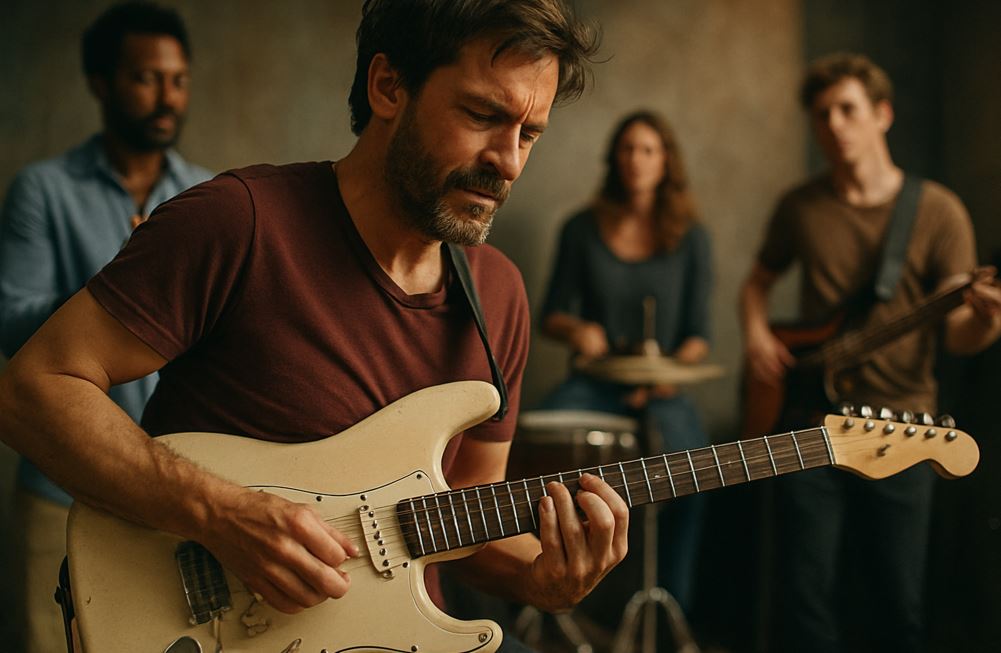
Becoming a ‘Rhythmic Being’ on Guitar
/by Dennis WingeDo you ever feel like your playing sounds precise—but not alive? Maybe your technique is clean, but your groove just feels a little off. Or perhaps you’ve battled awkward timing in soloing or comping, even when your fingers know the shapes.
I’ve discovered that what might be missing isn’t a new chord or lick—but a deeper connection to rhythm itself. In recent studies—like those with rhythm master Ronan Guilfoyle—I’ve learned that rhythm isn’t something you just play; it’s something you become. You make rhythm part of your body, your intuition, your musical identity.
That’s the difference between merely playing notes… and truly making music! In this post, I’ll show how guitarists talk about rhythm as embodiment—and why that matters for your playing, especially here, at Guitar Lessons Myrtle Beach.
Why Rhythm Matters More Than You Think
You might have taken lessons focused on chords, scales, or technique (all essential). But rhythm is the foundation beneath it all. Here’s why it matters:
-
It’s the difference between flat playing and musical feeling. Rhythm is what makes your strumming, soloing, and comping flow.
-
It’s what listeners—and bandmates—feel before they hear notes. They don’t hear your chord choices first—they feel your groove.
-
Weak rhythm creates constant struggle. You might “lose yourself” in solos, struggle with timing, or lack expressive nuance—all signs you’re not rhythmically connected yet.
When guitarists bridge this gap, everything unlocks: phrasing opens, confidence grows, and music breathes.
What Does “Becoming a Rhythmic Being” Mean for Guitarists?
Nobody uses the exact phrase “rhythmic being,” but many great guitarists imply it in their musical philosophy. Here’s how:
John McLaughlin
He speaks of the guitar as becoming an extension of the body. Rhythm, then, isn’t just movement—it’s embodied. When the instrument and player become one, rhythm flows from a deeply internal place.
Mårten Hagström (Meshuggah)
Says the guitar is less about technique and more about expressing what’s inside—mind and heart. Rhythm becomes less about counting and more about projecting internal energy.
Preston Reed
Transformed acoustic guitar into a percussive powerhouse—tapping, slapping, and drumming on the guitar. Rhythm, in his world, is as tactile and physical as possible.
David Leisner
Emphasizes bodily awareness and large muscle engagement—especially vital in his recovery from focal dystonia. He treats rhythm and technique as physical coordination.
Paul Simon
Composed with rhythm as the creative starting point. Rather than fit melody to rhythm, he’d build melody around rhythm—making rhythm the origin of musical expression.
Guitarists on Reddit
Two common insights:
-
“Rhythm is the single most important aspect in all music…”
-
“Poor rhythm is like body odor: it makes it hard for people to be around you.”
These voices all say: rhythm isn’t optional—rhythm is what makes you musical.
The Science Behind Embodied Rhythm
Ironically, rhythm education used to lean heavily on counting “1‑e‑&‑a.” Modern research shows what musicians already know: rhythm is embodied.
-
Sensorimotor coupling: Rhythm perception and production develop through hearing, moving, and reacting—all at once. It’s not separated into “what you hear” and “what you do.”
-
Entrainment as social-musical glue: When musicians sync up, they do more than play together—they feel together. That rhythm connection strengthens expressivity and interaction.
This is why drummers, rhythm guitarists, and even bass players talk about being the heartbeat—not playing over rhythm.
How Embodied Rhythm Transforms Guitar Playing
When rhythm moves from our heads into our body and intent, it changes everything:
-
Freer, more expressive technique
When rhythm is internal, your body follows rhythm because it feels right. You stop clinging to rigidity and begin to swim in the music. -
Groove that connects
You’ll stop counting and start floating. Strumming, comping, or riffing becomes less mechanical and more alive. -
Improvisation with purpose
Instead of just playing licks, rhythm becomes the pulse behind your musical ideas. You create with direction, not randomness. -
Playing in ensembles that lock in
It’s no longer “can I keep time?” but “can I feel us collectively.”
Practical Exercises for Guitarists to Embody Rhythm
Here are exercises to shift from counting to becoming rhythm:
1. Guitar Percussion Warmup
-
Open-hand tapping: tap the guitar body, wood, bridge. Explore a natural pulse.
-
Tap with thumb, root-note finger, and then shift between strings like percussion.
-
Focus on letting your body pulse; explore dynamics and feel.
2. Internalize the Beat by Physical Entrainment
-
Play a chord with rhythmic drive.
-
With your foot, tap pulse in front of you at head height—feel where your body naturally wants to tap.
-
Strum with that motion—body-led rhythm.
3. Floating Offbeats / Groove Exaggeration
-
Set a metronome to 60 bpm. Strum on the “and” (offbeat).
-
Move up to 80, 100 bpm—and don’t treat small spacing as harder. Just respond to the feel.
-
Then loop comping chords in sync with the body motion—not the metronome clicks.
4. Internal Rhythm Through Singing + Playing
-
Hum a simple melody—“Twinkle Twinkle” or a blues phrase—in quarter notes.
-
Strum on a rhythm pattern behind the humming line. Don’t match; layer.
-
Swap: hum the melody on offbeat pulses while playing chord onbeat.
5. Breath-Driven Rhythm
-
Let your breathing be the guide. Inhale on beat 1, exhale on beat 3.
-
Match strumming dynamics to breathing: strum strong on exhale.
-
Build rhythmic lifts tied to breath—pulse becomes organic.
Teaching Rhythm as Embodied Practice
At Guitar Lessons Myrtle Beach, I now integrate these embodied rhythms into lessons. Here’s how that beats traditional counting:
-
Movement before metronome. Start with body, then let time align—not vice versa.
-
Rhythm through intent, not chart. You respond to a pulse with physical awareness.
-
Groove with confidence. Whether you’re a beginner or advanced, rhythm becomes expressive, not mechanical.
-
Sustainable musicianship. You learn to feel rhythm, not think it—and that lasts.
Final Thoughts: Let Rhythm Be You
One student told me recently, “I’ve been playing guitar for years—notes, scales, songs—but I never really felt rhythm until this lesson.” After a few of the embodied exercises, they were rhythmically unlocked, and everything sounded more musical.
When guitarists learn to be rhythm—rather than chase it—they reach a new level of expressive power. Rhythm isn’t something they add to music. Rhythm is the music.
If this resonates with you, let’s work together. We’ll move rhythm into your hands, your body, your musical being—where it truly belongs.
Book a free trial lesson, available both in-person and online. Fill out this form and we’ll respond within 24 hours.
