
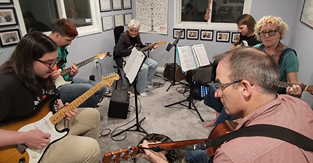
Why Jamming Is One of the Most Powerful Tools for Musical Growth
/by Dennis WingeThere’s a special kind of magic that happens in a jam session. It’s not just about playing music with others—it’s about listening, adapting, creating, and growing in ways that no solo practice session or theoretical study can replicate. Whether you’re a beginner venturing into your first jam or a seasoned player sharpening your skills, jamming holds immense value. It’s where the rubber meets the road, where all the theory and technique you’ve practiced gets tested in real time.
Here’s why jamming is one of the most powerful tools for musical development—and why it should be a regular part of every musician’s journey.
1. Jamming Trains Your Ear—And Forces You to Trust It
Many jam sessions happen without sheet music or chord charts. This means your ears—not your eyes—are in charge. You learn to listen closely: to chord changes, to form, to stylistic clues, to subtle variations in rhythm or phrasing. And this kind of active listening is where real growth happens.
For some players, especially beginners or early intermediates, this can be intimidating. But like any skill, ear training improves with use. Jamming is a form of musical immersion. You begin to recognize common progressions, hear tonal centers more clearly, and predict changes based on context.
Even if you get it “wrong,” you’re still learning. Trial-and-error in a real musical situation helps develop intuition. It trains your brain to connect what you hear with what you play, and builds a deeper, more internalized understanding of music.
And you don’t need to be a great singer to work on your ear. Many of the vocal-based exercises I assign students—like the pedal point exercise where you hold a root note and sing up and down the scale (1–2–1, 1–3–1, etc.)—can be done silently, internally, or using your instrument. The goal is to engage your inner ear and learn to navigate music from the inside out.
2. Jamming Sharpens Your Rhythm Skills
Rhythm is the glue that holds a band together, and a jam session is the ultimate testing ground. You’re not just keeping time—you’re locking in with the groove, responding to what others are doing, and contributing rhythmic energy to the ensemble.
You may find yourself adjusting your strumming to match a drummer’s hi-hat pattern, or creating a syncopated chordal rhythm that plays off a bass line. This kind of rhythmic interplay builds deep internal time and groove awareness—skills that are essential whether you’re comping, soloing, or supporting others.
Some students get used to playing by themselves or with a metronome, but when you’re in a jam, the rhythm is alive. You have to feel it, stay grounded, and still find your own pocket within the group’s momentum. That’s where the fun begins—and where your sense of rhythm gets stronger by the minute.
3. Jamming Builds Versatility in Style and Feel
Every jam is different. One tune might be a classic blues shuffle, the next a bossa nova, then maybe a reggae groove or a fingerstyle folk number. If you want to participate fully, you have to adapt—quickly.
Jamming exposes you to styles you might not normally play. That’s a gift. It broadens your musical vocabulary and helps you recognize the traits of different genres: the clave in Latin music, the swing feel in jazz, the snare emphasis in reggae, the open ringing quality of country.
This stylistic flexibility is one of the most valuable traits a musician can have. The more grooves you can lock into, the more collaborators you’ll be able to work with—and the more expressive you’ll become as an artist.
4. Chords, Voicings, and Comping Choices Matter
Jam sessions require real-time harmonic decisions. If someone else is playing open chords, maybe you move to barre chords, triads, or partial voicings higher on the neck to add texture. If the keyboardist is playing lush extensions, maybe you stick to simple shell voicings to stay out of their way.
The point is, you’re constantly adjusting. Jamming helps you get fluent with different chord shapes, inversions, and textures. It pushes you beyond just “playing the chords” and into thinking about how you’re playing them—what register, what rhythm, what dynamics.
And then there’s creative comping: using arpeggios, rhythmic patterns, voice leading, and chord substitution to bring interest and motion to your accompaniment. All of that gets practiced, tested, and refined in a jam.
5. Soloing and Improvisation in Context
Improvisation is a huge part of many jam sessions, and jamming is the perfect place to build your soloing skills. You get to try out ideas, experiment with phrasing, and develop melodic intuition—all while reacting to a live musical landscape.
It’s one thing to work out licks over a backing track. It’s another to solo over a chord progression that might not be what you expected, with a drummer who might speed up or slow down, and a bassist who’s taking liberties with the groove.
That’s where your real improvisational chops get built.
You’ll also start thinking about keys and scales differently. Instead of “playing in G major,” you’ll be thinking: “What works over this progression?” You’ll listen more, simplify when needed, and build solos that tell a story.
And you’ll learn one of the most important skills of all: phrasing. You’ll start playing phrases that sound like melodies—statements with shape and direction—instead of just running up and down scales. That’s when soloing really starts to feel musical.
6. Learning Jam Etiquette: A Crucial Social Skill
Jamming is social. And like any group activity, it works best when everyone respects each other and follows some basic etiquette.
That means knowing how to listen, when to take the lead, and when to step back. It means asking others what they’d like to play, making sure everyone gets a turn to solo, and not dominating the session with your own agenda.
If you’re not sure how to navigate jam situations, I’ve written a three-part article on [How to Jam] that outlines practical etiquette, unwritten rules, and ways to make the most of your experience (link coming soon).
Jam etiquette isn’t just about being polite—it’s about creating a musical space where everyone feels valued. That’s how great music happens.
7. Volume, Tone, and Dynamic Control
Your sound matters in a jam. If you’re too loud, you’ll overwhelm others. If you’re too quiet, you won’t be heard. If your tone is too bright or too dark, it might clash with the overall blend.
Jamming teaches you to listen to your sound in context. You learn to adjust your volume based on the setting—especially if you’re switching between comping and soloing. You become more aware of how your tone contributes to the overall mix.
And if you use pedals or effects, jams are a great place to experiment. What does a little chorus do to your comping tone? How does delay interact with the groove? What happens when you roll off the tone knob on your guitar?
These real-world tests help you refine your sound and build a setup that works for you—and for the music.
8. Building a Complete Musical Skill Set
Jamming is the ultimate integration of your musical skills. It draws on your:
-
Ear (for listening and adapting)
-
Time feel (to stay locked in)
-
Chord knowledge (to comp creatively)
-
Scales and theory (to solo musically)
-
Technique (to execute your ideas)
-
Expression (to make it feel like music)
-
Social awareness (to be a team player)
In other words, it’s where all the separate parts of your practice come together.
It’s also where you identify your weak spots. If you’re struggling to keep up, maybe your chord knowledge needs work. If your solo feels aimless, maybe it’s time to work on phrasing. Every jam is a diagnostic tool and an opportunity to grow.
9. Jamming as a Gateway to Songwriting and Collaboration
Jams often turn into songwriting sessions—especially if someone brings a new riff, chord progression, or idea to the table. If it’s simple and catchy enough, the whole group can jump in. That’s how many great songs are born.
Even if you’re not writing a full song, jamming gives you the chance to explore ideas in real time, get instant feedback, and co-create with others. That’s invaluable, whether you’re composing, arranging, or just playing for fun.
10. Real-World Growth: From Nervous Beginner to Confident Jammer
I’ve watched many of my students walk into our monthly jam sessions feeling nervous and unsure. Some of them barely knew a few chords. Some had never played with others before.
And yet, six months later, they’re smiling, grooving, soloing, interacting, and having a blast.
Jamming builds confidence. You realize you don’t have to be perfect to participate. You just have to show up, listen, and play your part. The more you do it, the more natural it feels—and the more fun it becomes.
Final Thoughts: Jam Sessions as a Lifelong Practice
Jamming is not a phase. It’s not just something you do once you “get good.” It’s a practice you return to again and again—because it sharpens your skills, reveals new challenges, and fills your musical life with community and joy.
If you’ve never been to a jam session, I encourage you to start. Ask a friend to play a blues with you. Join one of our student jam sessions. Attend a local open mic or jazz jam. Bring your curiosity, your humility, and your love of music.
You don’t have to know everything. Just come ready to listen, learn, and play.
That’s where the magic begins.
Book a free trial lesson, available both in-person and online. Fill out this form and we’ll respond within 24 hours.
