
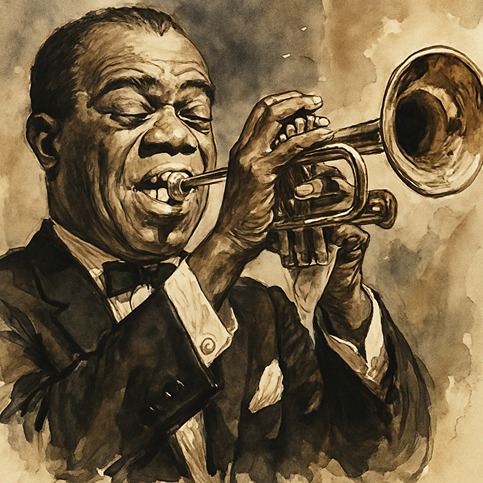
What Is Jazz?
/by Dennis WingeJazz is one of the most influential and boundary-breaking musical traditions in the world. But ask a dozen musicians what jazz is, and you’ll likely get a dozen different answers. Some define it through its history, others through its sound or techniques, and still others by its attitude: freedom, individuality, and interaction.
In this article, we’ll dive into both the history and the inner workings of jazz—including a closer look at the scales jazz musicians use and why. Whether you’re new to jazz or already learning your way around it, this is a chance to understand what makes jazz tick and how its unique sonic vocabulary came to be.
An American Art Form with Global Reach
Jazz began around the turn of the 20th century, primarily in New Orleans, a cultural melting pot where African, Caribbean, and European musical traditions mixed. It was not born from a single source, but from the layering of many musical voices across centuries.
African musical traditions provided its heartbeat: polyrhythms, cyclical repetition, improvisation, and the call-and-response dialogue between performers and audiences. These elements filtered into African American culture through Negro spirituals, work songs, and field hollers—music that expressed both hardship and hope, often using subtle rhythmic shifts and melismatic singing that later informed jazz phrasing.
Military brass bands, especially those influenced by French parade and marching traditions, contributed instrumentation (cornets, clarinets, trombones, drums) and the disciplined sense of ensemble that New Orleans musicians would transform into something looser, funkier, and more improvisatory. Ragtime, with its syncopated piano patterns and blend of African rhythm with European harmony, provided an essential link between structured dance music and the freer rhythmic push of early jazz.
At the same time, Afro-Cuban music and other Caribbean traditions introduced clave-based rhythmic frameworks and percussion styles that would become deeply embedded in jazz—from Jelly Roll Morton’s “Spanish tinge” to Dizzy Gillespie’s Afro-Cuban collaborations. European popular songs, especially Spanish and French ballads, supplied lyrical melodies and chord progressions that jazz musicians reinterpreted with new rhythmic vitality. Gospel songs and church music also played a key role, infusing harmonic richness, spiritual intensity, and a sense of communal uplift that carried into jazz’s expressive language.
Out of this vast stew emerged early jazz—an art form that was unmistakably American, yet unmistakably global in its DNA. And as soon as artists like Louis Armstrong began to shape it with individual brilliance—phrasing, rhythmic feel, and personal voice—jazz moved from being simply a folk hybrid to becoming one of the great artistic revolutions of the 20th century.
From Dance Halls to Listening Rooms
In the 1920s and 30s, jazz became the soundtrack of American nightlife. Big band swing, led by figures like Duke Ellington, Count Basie, and Benny Goodman, brought jazz to dance halls and ballrooms. This was jazz as popular music—grooving, infectious, and highly arranged for large ensembles.
Then came the 1940s—and a revolution.
Jazz musicians like Charlie Parker and Dizzy Gillespie pioneered a new style called bebop. Bebop was fast, harmonically complex, and full of rhythmic twists. Unlike swing, it wasn’t meant for dancing. It was music for listening, for playing, for pushing limits.
From bebop forward, jazz evolved rapidly:
- Cool Jazz (e.g., Miles Davis, Dave Brubeck): More relaxed tempos and smoother textures.
- Hard Bop (e.g., Art Blakey, Horace Silver): Earthier, gospel- and blues-influenced.
- Modal Jazz (e.g., Kind of Blue): Fewer chords, more space for melodic exploration.
- Free Jazz (e.g., Ornette Coleman, Coltrane’s later work): Emphasis on collective improvisation, often with no fixed harmony or rhythm.
- Fusion (e.g., Weather Report, Herbie Hancock): Blending jazz with rock, funk, Latin, and electronic sounds.
Today, jazz is a genre defined by diversity. There’s no one sound, no single formula. Jazz can be acoustic or electronic, traditional or experimental, straight-ahead or groove-based. The unifying threads? Improvisation, rhythmic intensity, harmonic exploration, and personal voice.
What Makes Jazz… Jazz?
So beyond history and style, what are the musical traits that make jazz what it is? Here are the big four:
1. Improvisation
Jazz musicians often create their parts in the moment. They might follow a structure (like a chord progression or a melody), but their solos are spontaneous compositions. This means strong listening skills, deep harmonic knowledge, and the courage to take risks.
2. Swing and Groove
Not all jazz “swings,” but the feel of jazz is always rhythmically alive. Swing rhythm involves a triplet feel (long-short subdivisions), while Latin jazz, funk-influenced jazz, or modern jazz may have very different grooves. Either way, time-feel is everything.
3. Interaction
Jazz is a conversation. Musicians don’t just play their parts—they respond to each other. A pianist might echo a drummer’s rhythm; a soloist might build off a bassist’s idea. Good jazz playing is like listening and speaking at the same time.
4. Personal Voice
Perhaps most importantly, jazz encourages musicians to find their own sound. Two saxophonists might play the same scale over the same chord, but sound completely different. That’s not just allowed in jazz—it’s celebrated.
What Scales Do Jazz Musicians Use?
This is a question students often ask after hearing an intricate solo or seeing a dense lead sheet. The short answer? Many scales. But more importantly, jazz musicians think of scales as sounds—not rules—and they choose them to fit the mood, the harmony, and the moment.
Let’s walk through the most important scales in jazz and why they matter.
1. Major Scale and Its Modes
The major scale is the foundation of Western music. In jazz, it’s used both in its pure form and as the basis for modes, which are variations created by starting the scale from different degrees.
The most common modes in jazz include:
- Ionian (Major) – used over major chords.
- Dorian – a minor sound with a raised 6th, great over minor 7 chords.
- Mixolydian – used over dominant 7 chords, with a flat 7.
- Lydian – like major but with a sharp 4, often used for a modern major sound.
These modes are particularly useful because they fit naturally over diatonic chords in jazz standards.
2. Melodic Minor Scale and Its Modes
The melodic minor scale is a goldmine for modern jazz.
It’s like a major scale with a minor third:
- 1 2 b3 4 5 6 7
This scale is the gateway to many advanced jazz sounds. Its modes include:
- Lydian Dominant (4th mode) – used over dominant chords with a #11.
- Altered Scale (7th mode) – used over V7 chords with lots of tension (b9, #9, #11, b13).
- Locrian ♮2 – used over half-diminished (m7b5) chords.
Jazz players often use these modes not just to match chords—but to add color and movement within a harmonic framework.
3. Blues Scale
The blues scale is a simple but powerful 6-note scale:
- 1, b3, 4, #4 (or b5), 5, b7
It doesn’t always fit “correctly” over every chord, but it works because of how it feels. It expresses tension and release in a raw, emotional way. Blues vocabulary runs through every style of jazz, from swing to fusion.
4. Pentatonic Scales
Jazz musicians often use:
- Minor pentatonic – 1, b3, 4, 5, b7
- Major pentatonic – 1, 2, 3, 5, 6
But they don’t just play them “inside” the key. They often superimpose them over chords to create tension or fresh melodic shapes. For example, over a C7 chord, a jazz soloist might use a D minor pentatonic to get a modern sound.
5. Diminished and Whole Tone Scales
These symmetrical scales are perfect for dominant chords that need tension.
- Half-Whole Diminished Scale: Used over dominant 7b9 chords. It has built-in alterations like b9, #9, #11, and 13.
- Whole Tone Scale: All whole steps—used over dominant chords with a #5 or #11.
These are not everyday scales, but jazz players keep them in their toolbox for when the harmony gets spicy.
6. Harmonic Minor Scale (Occasionally)
The harmonic minor scale (1 2 b3 4 5 b6 7) shows up sometimes, especially in Latin jazz or pieces with more classical influence. It can be used to generate exotic or dramatic sounds, but it’s less common than melodic minor in mainstream jazz.
Jazz Musicians Think in Sounds, Not Just Scales
Here’s a truth that can help students: Jazz musicians often don’t think in terms of “which scale goes with which chord.” At more advanced levels, they think in intervals, colors, and shapes. A scale is just one way to organize the sound they want.
- Over a dominant chord, do you want a plain sound? Use Mixolydian.
- Want tension? Try altered or diminished.
- Want a bluesy twist? Throw in a flat 3 or a sharp 4.
- Want modern color? Try a pentatonic from a different root.
In other words: theory helps, but your ears and taste guide the decisions.
Essential Listening
Nothing beats listening to jazz to truly understand it. Jazz is an aural tradition, a living, breathing art form best experienced through the music itself.
If you’re interested in going deeper with both reading and listening examples, a fantastic resource is the book Jazz: From Its Origins to the Present by Lewis Porter, Michael Ullman, and Edward Hazell. It pairs rich historical commentary with listening guides to many classic recordings.
But for now, here are 10 essential tracks, each from a different era or style of jazz. Together, they highlight some of the core musical traits that define the genre: improvisation, swing, interaction, harmonic innovation, and personal voice.
1. Louis Armstrong – “West End Blues” (1928)
One of the first jazz recordings to spotlight individual improvisation as art. Armstrong’s opening cadenza is breathtaking—fluid, lyrical, and commanding. This recording shows how early jazz was already bursting with expressive power and rhythmic drive.
2. Duke Ellington – “Mood Indigo” (1930)
A masterclass in orchestration, mood, and harmonic color. Ellington’s voicings turn traditional harmony inside out, using instruments in unconventional ranges. This piece reflects jazz’s early sophistication and emotional range during the swing era.
3. Count Basie – “One O’Clock Jump” (1937)
A high-energy swing-era anthem featuring blues riffs, call-and-response, and a driving rhythm section. Basie’s minimalist piano comping and the band’s infectious groove illustrate the essence of swing as dance music and as an engine of group interaction.
4. Charlie Parker – “Ko-Ko” (1945)
A pivotal bebop recording. Dizzying speed, intricate harmony, and tight ensemble playing mark this track. Parker’s improvisation over the changes to “Cherokee” demonstrates the bebop revolution: music as a vehicle for complexity and virtuosity.
5. Miles Davis – “So What” (1959)
The opening track from Kind of Blue, this tune launched modal jazz. It uses just two chords and the Dorian mode, encouraging melodic freedom and spacious phrasing. The band (with Coltrane and Bill Evans) shows how less can be more.
6. John Coltrane – “My Favorite Things” (1961)
A transformation of a show tune into a hypnotic, modal jazz exploration. Coltrane stretches the harmony and meter, showing how repetition and rhythmic displacement can create trance-like intensity. Also a landmark soprano saxophone performance.
7. Herbie Hancock – “Maiden Voyage” (1965)
This track epitomizes post-bop: modern harmony, lyrical modal improvisation, and subtle rhythmic shifts. The tune floats on suspended chords and explores sophisticated tonal colors without losing accessibility. Herbie’s touch is deeply melodic and modern.
8. Ornette Coleman – “Lonely Woman” (1959)
A cornerstone of free jazz. There’s no steady pulse or traditional chord changes—just pure emotional communication. Ornette’s alto sax sings with a plaintive, vocal quality. This track expands what “jazz” can be without abandoning melody or feeling.
9. Weather Report – “Birdland” (1977)
A defining moment in jazz fusion. Synths, funk grooves, and electric bass blend with jazz improvisation. Jaco Pastorius’ bass playing alone is worth the listen. This track shows jazz’s ability to evolve and absorb new influences without losing its core.
10. Esperanza Spalding – “I Know You Know” (2008)
A modern blend of jazz, soul, and pop, performed by a virtuosic bassist and singer. Spalding brings jazz into the 21st century with fresh grooves, rich harmony, and effortless improvisation. A perfect example of jazz’s continuing vibrancy and crossover potential.
Whether you’re a student, a fan, or a curious newcomer, these tracks offer a guided listening journey through jazz history. Each one opens a window into the genre’s evolution and spirit.
You can find all these tracks on most streaming platforms—or better yet, listen to them while reading liner notes, watching live footage, or exploring different versions of the same tune by other artists.
Jazz is a language—and listening is how you learn to speak it.
Learn the Rules, Then Break Them
Jazz is a music of tradition, but also of innovation. Learning the scales jazz musicians use is a vital step—but so is learning the art of applying them creatively.
Here’s a practical tip: pick a tune you like. Learn the melody. Understand the chord changes. Then try playing just one or two of the scales mentioned above over the chords—experimenting with different options. Notice how each scale brings a different feeling. That’s the heart of jazz: expressing something personal within a structure.
In the end, jazz is more than just “theory” or “chords” or “scales.” It’s a mindset. A way of playing. A way of listening. A way of communicating.
And that brings us back to Louis Armstrong’s famous words:
“If you have to ask what jazz is, you’ll never know.”
At first glance, it might sound like a dismissal—but really, it’s an invitation. Armstrong wasn’t saying jazz is unknowable—he was saying that jazz is something to be felt, lived, played, and heard. You don’t understand jazz by defining it. You understand it by experiencing it.
So listen deeply. Play boldly. Study the theory—but don’t let it cage you. The scales, the rhythms, the history—all of it is just a doorway. What’s on the other side is yours to discover.
Book a free trial lesson, available both in-person and online. Fill out this form and we’ll respond within 24 hours.
