
Why Guitar Music Sounds Lower Than It Looks
/by Dennis WingeIn this article, we’ll explore why guitar music is written an octave higher than it sounds, what that means in practical terms, how it affects ensemble playing, and why this convention actually helps guitarists rather than hinders them.
What Does It Mean That Guitar Sounds an Octave Lower Than Written?
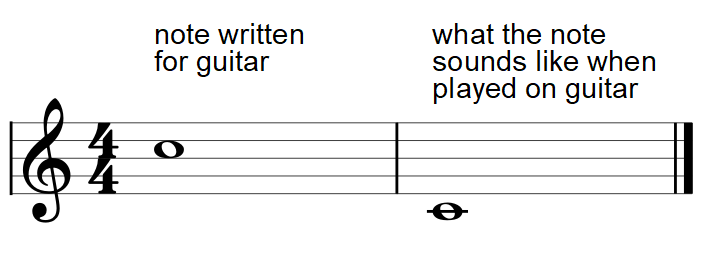
In standard music notation, the notes you see on the staff represent pitches. For most instruments, what you read is what you hear. If a violinist reads a G on the second line of the treble clef, they play and hear that exact G. But for guitarists, that same G — when read in standard notation — will sound an octave lower than it looks on the page.
This is called transposition by octave, and it’s a common practice for certain instruments, including:
- Guitar (written an octave higher than it sounds)
- Double bass and bass guitar (written an octave higher)
- Piccolo and xylophone (written an octave lower than they sound)
So, when a guitarist plays the E on the top space of the treble clef (1st string open), it actually sounds like the E an octave below what’s written.
Why Is Guitar Notated This Way?
1. Readability and Practical Layout
If guitar music were written at its true sounding pitch, many of the notes would fall below the staff — sometimes well below it. This would require lots of ledger lines, which makes reading difficult, especially in fast or complex passages.
By writing the music one octave higher, the full range of the guitar fits neatly within the treble clef, making it much easier to sight-read and analyze.
2. Tradition and Standardization
Guitar notation has been standardized this way for centuries. If composers and arrangers suddenly switched to sounding pitch, it would disrupt the entire library of existing guitar literature and confuse generations of players who have learned the conventional system.
3. Consistency Across Instruments
Guitarists often play with vocalists, pianists, or horn players, and all of those instruments read music at concert pitch (the actual sounding pitch). To maintain a consistent visual notation across the board, guitar music follows this octave transposition convention.
A Real-World Example
Let’s say you read a middle C (first ledger line below the treble clef). On guitar, this note is found at the 3rd fret of the A string (5th string). However, when you play that note, you’re actually producing a C that is an octave below middle C — the one that is more commonly associated with low-range instruments like cello or bassoon.
If you play the same sheet music as a violinist or flutist, you’ll both read the same notes on the page. But when you both play, the violin or flute will sound one octave higher than your guitar.
What If You Want to Hear the True Written Pitch?
If you’re curious or skeptical, here’s a way to test it:
- Get a piano or digital keyboard.
- Play the note as written on your guitar (say, the 1st string open E).
- Now, find that exact-sounding note on the piano.
- You’ll notice that the correct pitch is one octave lower than the written E on the top space of the treble clef.
A digital tuner that displays note names and octaves can also help. It will show that your high E string is actually E4, even though it’s written as E5 on the staff.
What About Tablature?
Guitarists often use tablature (tab) notation, which tells you exactly where to place your fingers but doesn’t convey rhythmic or pitch information the way standard notation does. Tablature sidesteps the octave issue entirely — it’s neither transposed nor pitched in any specific way.
That said, if you’re reading tab and standard notation together (which is common in modern guitar books), just remember that the notation is still written an octave above the actual sound.
Does This Affect Playing with Other Instruments?
Yes, but only in terms of awareness — not in practice. If a pianist is reading a concert C, and you’re reading a concert C on the guitar, you’ll both be reading the same thing — but you will sound one octave apart.
This is usually not a problem in ensemble settings because arrangers and composers know about the transposition. They write guitar parts with this in mind. For example, a duet between guitar and flute will have parts that look identical on paper in terms of pitch, but the flute will sound an octave above the guitar.
In jazz and pop lead sheets, the same rules apply: chords and melody lines are written as if they sound at pitch, but guitarists play them an octave lower by default — without changing the fingerings or notes.
How Do Other Instruments Handle This?
Several other instruments are written in transposing notation for similar reasons:
- Double Bass / Bass Guitar: Also written an octave higher than sounding pitch. This allows their music to be read in the bass clef without too many ledger lines below.
- Piccolo and Xylophone: These are written an octave lower than they sound, so their high notes don’t go off the top of the staff.
- Tenor Voice in Choral Music: Written in treble clef an octave higher than it sounds.
These conventions are designed to keep reading simple and practical — not to confuse musicians!
How to Explain This to Students
This is a sticking point for many students, especially when comparing guitar to piano or working with theory exercises. Here’s a way to explain it:
“When we write music for guitar, we pretend it sounds higher than it actually does — so it fits on the page better. But when you play the note, it comes out lower. You don’t have to do anything different. Just know that your guitar is tuned to sound one octave lower than what’s written. It’s like a trick of the eye that makes the music easier to read.”
You can also demonstrate this by using a digital piano or audio software to compare the notes, which gives an aural “aha!” moment.
Should Guitarists Ever Read at True Pitch?
Only in very rare academic or experimental settings. In nearly all published guitar music — classical, jazz, rock, pop, or otherwise — the convention remains: notation is an octave above sounding pitch.
It’s best to simply internalize this and not try to fight it. When studying music theory, just keep in mind that your guitar is effectively a transposing instrument, like a B-flat trumpet or alto saxophone, but with an octave shift rather than a different key.
Final Thoughts
The fact that guitar sounds an octave lower than written is not a mistake, a fluke, or something to worry about. It’s a practical convention that makes guitar music easier to read and play. Once you understand the reason behind it, it becomes second nature.
So the next time you read that your open high E string is written on the top space of the treble clef, just smile and remember — it’s secretly one octave lower, and that’s totally okay. That’s the beauty of guitar: it breaks the rules just enough to be unique, but not enough to be confusing — once you know the trick.
Understanding this one detail can help you communicate more clearly with other musicians, avoid confusion when working with theory, and build confidence in reading and interpreting music. And ultimately, it reminds us that music isn’t just about what’s on the page — it’s also about what we hear and feel.
Book a free trial lesson, available both in-person and online. Fill out this form and we’ll respond within 24 hours.