
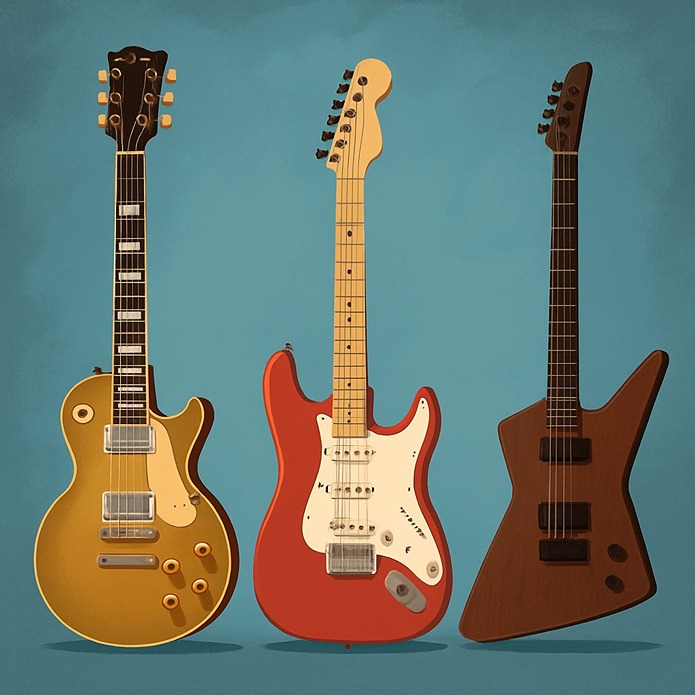
Les Paul, Strat, or something else?
/by Dennis WingeFrom the moment the electric guitar became the voice of modern music, players have gravitated toward two legendary archetypes: the Gibson Les Paul and the Fender Stratocaster. Both iconic in design, feel, and tone, these instruments helped shape the sound of virtually every genre from rock and blues to metal, funk, and pop. Yet not every great guitarist fell into either camp. Some players carved their own paths with unusual, custom, or boutique guitars. This blog explores the guitar heroes who made these instruments famous—both vintage and modern—and compares their defining qualities, tones, and legacies.
In the 1960s and ’70s, the Gibson Les Paul reigned supreme among rock guitarists. Its thick, sustaining tone, paired with the rise of Marshall amplification, created the blueprint for hard rock and blues-rock. Players like Jimmy Page, Duane Allman, and Peter Green prized the Les Paul for its weighty tone, which cut through loud bands with warmth and authority. Additionally, the mystique of the ’59 burst—a rare and beautifully crafted version of the Les Paul Standard—cemented its status as a grail guitar.
However, by the 1980s and into the 21st century, the Stratocaster began gaining broader appeal among a wider range of professional musicians. The reasons were both practical and tonal. Strat-style guitars are generally lighter, more ergonomic, and more modifiable. With a contoured body, deep cutaways, and versatile electronics, they accommodate a huge variety of styles—from clean funk to gain-heavy blues-rock to modern pop. As genres blended and playing techniques evolved, many players found the Strat’s sonic flexibility more adaptable to the demands of modern gigs and sessions.
Professional players often choose instruments based on a mix of tone, comfort, and stage functionality. For touring, a lighter and more modifiable guitar (like a Strat or Suhr-style super-Strat) may be preferred. For sessions, a guitar that covers a wide tonal range with minimal effort is ideal. Players today are less likely to be brand loyalists and more likely to select tools that fit the song, the genre, or the moment. That’s part of why even traditionalists are increasingly exploring offsets, headless guitars, and custom builds.
The Legends of the Les Paul
Historic Players:
1. Jimmy Page (Led Zeppelin)
- Perhaps the most iconic Les Paul player of all time.
- His 1959 Les Paul Standard defined the epic sound of songs like “Whole Lotta Love” and “Stairway to Heaven.”
- Thick, mid-heavy tone ideal for riff-driven hard rock.
2. Slash (Guns N’ Roses)
- Known for his sunburst Les Paul Standard.
- “Sweet Child O’ Mine” and “November Rain” showcase the Les Paul’s soaring lead tone and creamy sustain.
3. Duane Allman (The Allman Brothers Band)
- Used a Les Paul Goldtop and later a tobacco burst Standard.
- His slide tone on “Statesboro Blues” is legendary.
4. Peter Green (Fleetwood Mac)
- Played a 1959 Les Paul with out-of-phase pickups.
- Iconic for his haunting tone on “Albatross” and “Black Magic Woman.”
5. Gary Moore
- Played Peter Green’s actual Les Paul.
- Famous for emotionally charged solos on tracks like “Still Got the Blues.”
Modern Players:
6. Joe Bonamassa
- A Les Paul aficionado and collector.
- Uses vintage bursts and Custom Shop models for modern blues-rock.
7. Zakk Wylde (Ozzy Osbourne, Black Label Society)
- Known for his bullseye Les Paul Custom.
- Heavy distortion, pinch harmonics, and sustain make it a metal weapon.
8. Jared James Nichols
- Plays a Les Paul Custom with a single P-90 pickup.
- Old-school, aggressive blues tone.
9. Neal Schon (Journey)
- Known for lush lead tones and melodic phrasing.
- Often used Les Pauls throughout the ’80s and ’90s.
10. Randy Rhoads
- Played a white Les Paul Custom in Ozzy’s early solo work.
- Balanced classical lines with metal riffage.
The Stratocaster Icons
Historic Players:
1. Jimi Hendrix
- The definitive Strat player.
- Used Fender Strats upside-down (he was left-handed) for songs like “Voodoo Child,” “Little Wing,” and “Purple Haze.”
- Iconic for fuzzed-out, whammy-laden tones.
2. Eric Clapton
- Transitioned from Les Paul to Strat in the ’70s. Eric Clapton’s switch from the Gibson Les Paul to the Fender Stratocaster in the early 1970s was both sonic and symbolic. After using a Les Paul during his time with John Mayall’s Bluesbreakers and early Cream, Clapton began searching for a cleaner, more nuanced tone. The Strat offered him a broader palette—its single-coil pickups allowed for greater tonal clarity and expressiveness, especially when playing with dynamics and touch.
- He also found inspiration in seeing artists like Jimi Hendrix and Buddy Guy use the Strat to great effect. Clapton eventually assembled his famous “Blackie” from parts of three different Stratocasters and used it extensively during his solo career. For him, the Stratocaster offered a voice that was more refined, articulate, and versatile, fitting his transition toward more laid-back, song-oriented material like Wonderful Tonight and Lay Down Sally. The guitar’s ergonomic comfort and shimmering tone became a key part of his evolving sound and identity as an artist.
- “Blackie,” his favorite Strat, was used on “Wonderful Tonight” and “Lay Down Sally.”
3. Buddy Holly
- One of the earliest Strat ambassadors.
- Helped define the instrument’s place in rock ’n’ roll.
4. Jeff Beck
- One of the most expressive Strat players.
- Used fingerpicking, tremolo, and volume swells to masterfully shape tone.
5. David Gilmour (Pink Floyd)
- The “Black Strat” powered legendary solos on “Comfortably Numb” and “Shine On You Crazy Diamond.”
Modern Players:
6. John Mayer
- From Fender signature models to PRS Silver Sky (a Strat-style guitar).
- Clean blues tone with nuanced phrasing.
7. Mark Knopfler (Dire Straits)
- Fingerstyle Strat player.
- Songs like “Sultans of Swing” define articulate clean tone.
8. Yngwie Malmsteen
- Scalloped fretboard Strat.
- Shred meets Baroque; tons of vibrato and speed.
9. Cory Wong (Vulfpeck)
- Strat-based tone with super-clean compression.
- Modern funk rhythm king.
10. Nile Rodgers
- Played his iconic Strat “The Hitmaker.”
- Responsible for clean disco-funk grooves on hits by Chic, Daft Punk, and more.
Les Paul vs. Stratocaster: Side-by-Side Comparison
| Feature | Gibson Les Paul | Fender Stratocaster |
|---|---|---|
| Body | Solid mahogany with maple cap | Contoured alder or ash |
| Pickups | Two humbuckers | Three single-coils |
| Tone | Warm, fat, and sustained | Bright, scooped, and articulate |
| Weight | Heavier (8–10 lbs) | Lighter (6.5–8 lbs) |
| Scale Length | 24.75″ (shorter, easier bending) | 25.5″ (snappier attack) |
| Bridge | Fixed Tune-O-Matic | Tremolo system (vibrato) |
| Controls | 2 volume, 2 tone, 3-way switch | 1 volume, 2 tone, 5-way switch |
| Sustain | Excellent | Moderate |
| Mod Potential | Less common | High (many aftermarket options) |
Each guitar’s strengths make it ideal for different styles. Les Pauls excel in thick lead tones and heavy riffing; Strats shine in expressive soloing and percussive rhythm work.
The Outliers: Iconic Players Who Used Neither
Many legendary guitarists forged their sound using instruments that weren’t Les Pauls or Strats. These players often went for semi-hollows, odd shapes, headless models, or boutique builds.
Historic Players:
1. B.B. King – Gibson ES-355 “Lucille”
2. Chuck Berry – Gibson ES-335
3. George Harrison – Gretsch Duo Jet, Rickenbacker 360/12
4. Wes Montgomery – Gibson L-5CES
5. Bo Diddley – Custom rectangular Gretsch guitars
6. Brian May – Homemade “Red Special”
7. Prince – Hohner Tele-style, Cloud guitar, Symbol guitar
8. Tony Iommi (Black Sabbath) – Gibson SG
9. Andy Summers (The Police) – Fender Telecaster, Roland synth guitars
10. Billy Gibbons (ZZ Top) – Pearly Gates Les Paul (classic era), but often played Gretsch, Guild, and custom guitars live
Modern Players:
11. Tosin Abasi (Animals As Leaders) – Abasi Concepts 7- & 8-string headless guitars
12. Tim Henson (Polyphia) – Ibanez TOD10
13. John Petrucci – Ernie Ball Music Man Majesty
14. Mateus Asato – Suhr Classic S
15. St. Vincent (Annie Clark) – Music Man St. Vincent signature
16. Kevin Parker (Tame Impala) – Rickenbackers, custom mods
17. Isaiah Sharkey – D’Angelico semi-hollows, PRS
18. Jack White – Airline Res-O-Glas, custom Gretsches
19. Ed O’Brien (Radiohead) – Fender Sustainer Strat, Starcaster
20. Nels Cline (Wilco) – Fender Jazzmasters, custom builds
21. Johnny Marr – Fender Jaguar, Rickenbacker 330
22. Jim Root – Fender Jazzmaster (modded with humbuckers)
23. Tom Morello – “Arm the Homeless” custom, Kramer, Ibanez
24. Gary Clark Jr. – Epiphone Casino, ES-335
25. Susan Tedeschi – Fender Telecasters, semi-hollows
These artists often chose their instruments for feel, uniqueness, and expression more than tradition. Many wanted to avoid the “default” tones associated with Les Pauls and Strats, instead opting for something more personal.
Conclusion
The Gibson Les Paul and Fender Stratocaster remain pillars of electric guitar history, beloved for their craftsmanship, tone, and cultural weight. But as this blog shows, the world of guitar extends far beyond these two icons. Whether it’s a searing Les Paul solo, a shimmering Strat chord, or a wild fusion riff on a headless 8-string, it all comes down to the player’s voice.
So which side of the fence are you on? Or are you forging your own path entirely?
No matter your choice, the legacy of these instruments—and the artists who wield them—continues to inspire guitarists everywhere.
Book a free trial lesson, available both in-person and online. Fill out this form and we’ll respond within 24 hours.
