
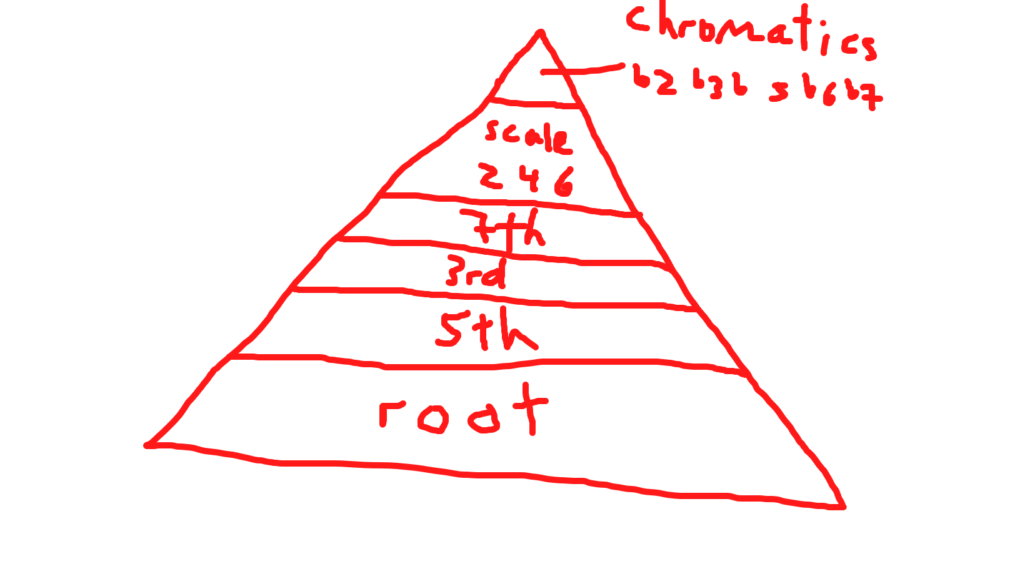
The Food Pyramid of Harmony
/by Dennis WingeWhen I teach my students how to transcribe music, I always emphasize that it all starts from the bass. But often, I hear the same complaint: “I can’t hear the bass!” If that sounds like you, there are two possible reasons:
- Your audio setup is holding you back. Many phones and laptops don’t reproduce low frequencies well. You need good headphones or proper speakers to hear the bass clearly.
- You haven’t trained your ear to pick out the bass in songs. But don’t worry—you absolutely can develop this skill with practice!
A great way to start is by listening to reggae music, where the bass is always prominent. Reggae basslines are clear, melodic, and sit at the forefront of the mix, making them an excellent training ground for ear development. Try focusing only on the bassline, ignoring everything else. With time, your ears will start to lock into the low frequencies.
Once you can reliably hear the bass, you’re ready to move up the harmony pyramid. In this blog, I’ll break down a hierarchical approach to understanding harmony, from the foundation of the bass up to the highest chromatic tones. This framework will help you transcribe music, understand chord structures, and develop a deeper sense of harmonic function.
Building Harmony from the Ground Up
Music, like nutrition, has its own “food pyramid” of essential ingredients. At the foundation are the most important notes that define harmony, while at the top are the chromatic and altered tones that add color and tension.
The key idea is prioritization: When transcribing music or analyzing a song, start with the most important notes first and work your way up—just like building a strong meal plan with a solid foundation before adding flavor.
The most important notes are, in this order:
- Root – Establishes the chord’s fundamental identity.
- Fifth – Reinforces stability but does not define major/minor.
- Third – Determines whether the chord is major or minor.
- Seventh (if present) – Adds harmonic tension and character.
- Scale Tones (2, 4, 6) – These fit naturally within the scale but are not always part of the chord.
- Chromatics (♭2, ♭3, ♭5, ♭6, ♭7) – These add tension, color, and motion.
So for triad chords, there are:
- 3 chord tones (root, third, fifth),
- 4 scale tones (2, 4, 6, and 7 if present),
- 5 chromatic tones (♭2, ♭3, ♭5, ♭6, ♭7).
For seventh chords, the distribution shifts slightly:
- 4 chord tones (root, third, fifth, seventh),
- 3 scale tones (2, 4, 6),
- 5 chromatic tones (♭2, ♭3, ♭5, ♭6, ♭7).
… and a partridge in a pear tree! 🎶
The plot thickens, though, because each chord contains a different combination of intervals, which means the hierarchy will shift slightly depending on the chord type. The scale tones and chromatics associated with a chord depend on its function within the key.
Let’s break it down by chord type, starting with major and minor chords, then moving into dominant, diminished, and fully diminished chords.
Major and Minor Chords
Major Chord Pyramid (e.g., C major = C – E – G)
-
Foundation (Chord Tones):
- Root (1) → The most important note, establishing the key.
- Fifth (5) → Reinforces the harmony, but doesn’t define major/minor.
- Major Third (3) → Determines the major quality of the chord.
-
Scale Tones (Non-Chord Tones):
- 2 (D), 4 (F), 6 (A), 7 (B) → These notes are found in the major scale and can function as melodic passing tones or extensions.
-
Chromatic Tones (Altered Tones & Tensions):
- ♭2 (D♭), ♭3 (E♭), ♭5 (G♭), ♭6 (A♭), ♭7 (B♭) → These create tension, often leading to resolution.
Minor Chord Pyramid (e.g., A minor = A – C – E)
-
Foundation (Chord Tones):
- Root (1) → Establishes tonality.
- Fifth (5) → Functions similarly to the major chord.
- Minor Third (♭3) → Defines the minor quality of the chord.
-
Scale Tones (Non-Chord Tones):
- 2 (B), 4 (D), ♭6 (F in Aeolian mode) → These fit within the minor scale.
-
Chromatic Tones (Altered Tones & Tensions):
- ♭2 (B♭), 3 (C#), ♭5 (E♭), 6 (F#), 7 (G#) → Depending on the scale (melodic minor, harmonic minor, etc.), some of these might function as scale tones rather than chromatic alterations.
Key takeaway: The third (3 or ♭3) is the most defining tone for determining major vs. minor, while the other scale tones and chromatic tones add color and movement.
Dominant Chords
Dominant Chord Pyramid (e.g., G7 = G – B – D – F)
-
Foundation (Chord Tones):
- Root (1) → Establishes the dominant function.
- Fifth (5) → Reinforces stability.
- Major Third (3) → Essential for making it dominant.
- Flat Seventh (♭7) → This is what creates the tension that demands resolution.
-
Scale Tones (Non-Chord Tones):
- 2 (A), 4 (C), 6 (E) → These fit within the dominant scale.
-
Chromatic Tones (Altered Tensions):
- ♭2 (A♭), ♭3 (B♭), ♭5 (D♭), ♭6 (E♭), 7 (F#) → These create tension, often appearing in altered dominant contexts.
Key takeaway: The dominant chord is all about tension and resolution, and the ♭7 is crucial to making it work.
Diminished and Fully Diminished Chords
Half-Diminished Chord Pyramid (m7♭5, e.g., Bø = B – D – F – A)
-
Foundation (Chord Tones):
- Root (1), Diminished Fifth (♭5), Minor Third (♭3), Flat Seventh (♭7).
-
Scale Tones (Locrian Mode):
- ♭2 (C), 4 (E), ♭6 (G) → Standard Locrian tones.
-
Chromatic Tones (Tensions & Alterations):
- 2, 3, 5, 6, 7 → These create interesting colorations in melodic contexts.
Fully Diminished Chord Pyramid (°7, e.g., B°7 = B – D – F – A♭)
-
Foundation (Chord Tones):
- 1, ♭5, ♭3, ♭♭7 (which is enharmonic to 6).
-
Scale Tones (Whole-Half Diminished Scale):
- 2, 4, ♭6, 7 → These are symmetrical, forming an 8-note scale.
-
Chromatic Tones (Altered Notes):
- ♭2, 3, 5, ♭7 → These create tension and resolve outward or inward.
Key takeaway: The diminished chord is unique in that all of its intervals repeat every minor third, making it functionally ambiguous.
How to Use the Harmony Pyramid in Transcription
- Start with the bass. Train your ears to hear it clearly.
- Identify the root, then the fifth. This helps define the chord’s structure.
- Listen for the third. This determines whether it’s major or minor.
- Identify the 7th (if present). This helps distinguish between different chord types.
- Fill in scale tones and chromatics as they appear in the melody or accompaniment.
By following this structured approach, you’ll be able to analyze, transcribe, and understand harmony much more effectively.
So, next time you struggle with transcription, think of harmony like a food pyramid—build from the ground up, and you’ll never go hungry for notes!
Book a free trial lesson, available both in-person and online. Fill out this form and we’ll respond within 24 hours.
