
Jazz Rhythm
getting started
rhythms in jazz
pdf: rhythms in jazz
How African 6/8 is connected to 4/4 swing
incorporating Afro-Cuban 6/8 clave into 4/4 swing
tips from Charles Harrison
Charles Harrison
—-
metheny quote: “I have always felt that having good time and good feel is far and away the most important aspect of what makes a musician compelling to listen to. It isn’t fun to listen to or play with someone who doesn’t groove. There are musicians who have all kinds of advanced harmonic fluency and lots of chops but have a hard time playing a convincing idea with a deep connection to time. Without a deep pocket of some kind it is rare that music achieves that kind of connection. To me a note that is not placed right with the rhythm section or in the wrong context of the music that is being presented is the same as if it is a big giant clam, a wrong note. I hear people kind of letting it go as if it’s fine to be way ahead or behind or all over the place. Step one is to be aware of how it is all feeling. Playing with a metronome or a drum machine or sequencer is a good thing, but the best is to play with other people who have good time feels, particularly drummers. It is certainly something that you can work on. Pretty much everyone at every level has plenty of work to do in this department, myself included.”
counting, timing, groove, swing etc. are all very closely related; focus entirely on rhythm and don’t play things that make your rhythm suffer
rhtyhmic accuracy is not metronomic; groove / feel / swing is more interested in how subdivisions are divided – it’s how well you’re locked in with others within the style – play along with recordings and align it with recording, even just by listening it and not playing along; extract “groove template” from recordings
—-
tuplets & polyrhtyms
tuplet is a ratio like 3:2, 6:4, 5:4,
can divide a beat into any number of subdivisions, like 1 a pot a mus 2 a pot a mus (for 5s)
take first number (ex: 3:2) and that’s the counting row you use; look at how many you’ll have to count it over which tells you the starting point for each cycle
ex: 5:4
the five tells us to divide each beat into 5 subdivisions but count them in groups of 4
ex: 7:3
seven subdivsions per beat grouped in 3s over 3 beats
1. first number tells us subvisions per beat
2. how many whole beats the tuplet will cross
3. group the subdivision accordingly
—-
there is a spectrum of amount of swing and also amount of swing from precision like martino to looseness like scofield
1. upbeat accent – | 1 2 3 4 | 1 2 3 4 | where 4 of bar 2 gets accent, or even tie it over to the next 1, Hal Galper (in “The Zone”) said that’s the key to syncopation
2. upbeat accent | 1 & 2 & 3 & 4 & | where & of 4 is accented
3. alternate between accenting the and of 4 and the 4 in 2 back to back bars
4. apply swing to this by playing these patterns along with your favorite player’s recordings, adjusting amount of swing accordingly, and even play scale in key but continue the accents
—-
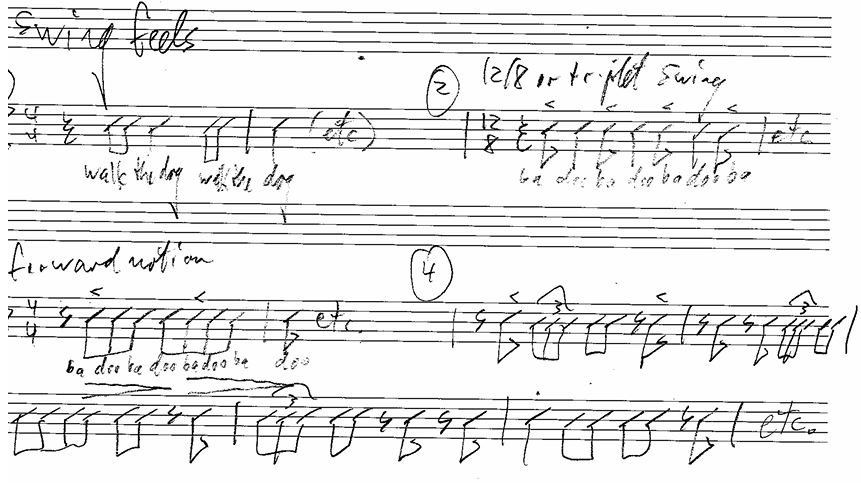
forward motion by Hal Galper
1. think in half time
2. line always moves towards beats 1 & 3, so accent & of 1 and continue getting quieter in 8ths until beat 3, then accent the and of 3 and do the same until beat 1
i.e. BA doo b d BA doo b d
anything you play, force that phrasing over it for a couple of months
then on top of that you can add bebop lines; this was life-changing
—-
16th notes and how to swing them
listen to Brecker, Scofield, Metheny & look at the way they group them together, i.e. where the accenting & phrasing
Longo’s rhythm pile is about how they are grouped
1. groups of 3 16ths
2. groups of 5
3. pair 2 groups ex: 3 + 5 resolves to 1; even want to keep it unresolved, pair odd and even groups like 3, 4, 3, 2, 5, 4, 3, 2
—-
what a metronome is actually for
get robotic device to feel like it’s grooving
1. four on the floor and play explore different subdivisions of each beat
2. click on 1 and 3 only
3. click on 2 and 4 only
4. click on 4 only
5. 1 click per 2 bars (on any beat)
6. 1 click per 4 bars (on any beat)
7. different pitches for triplet groove as in:
|—2–a3-a4-a|1-a2-a—4-a|
—-
1. emulate conversational phrases, i.e. rhythm first
2. forward motion (Hal Galper) – something has a feeling of forward motion or not, like 16th notes accenting each downbeat doesn’t have forward motion, but starting on the e of 1 does, for example, there’s a sense of propulsion there
3. ontological (Mike Longo) – by tapping into the Source, we allow that source to guide you; make a clear positive statement and then 2nd phrase is a reiteration of that (either a repetition, or similar but not identical) and then the direction unravels from there; start with something simple, repeat it (ish) and let the rest unfold
—-
(see photo below)
—-
Dizzy swing & Long rhythm pile
(see Dennis’ summary of Mike Longo’s Rhythmic Nature of Jazz)
tips from Marbin
taken from https://youtu.be/yjkftKWK3P4?si=j-evNEqvWCD4rS2p
swing feel
first, sway side to side & feel swing in your body, then access specific feels:
1. feel 8th note triplets & swing 8th notes (1st & 3rd triplets of each beat)
2. accented swung 8th notes like a New Orleans drummer (straighter and more laid back, like Joe Pass)
3. lots of 8th note triplets
4. 16th notes, but feeling in half-time (like fusion players a la Holdsworth)
5. same as 5 but perhaps more space
6. more precise 16th notes, a la Cannonball Adderley or George Benson
tips from Kieren Brereton
taken from https://www.youtube.com/watch?v=yavnCOYqbhg and https://www.youtube.com/watch?v=KnB1_5gk6Tk&t=1s
Swing is not a technique you add to your playing. It’s an emergent property that results from an entire musical ecosystem. Most traditional explanations (“make the eighth notes long-short,” “play triplets,” “just listen to the masters”) describe only isolated pieces of that ecosystem and therefore leave many students frustrated.
Part 1: Swing Is an Ecosystem
The author argues that swing emerges from many musical elements working together, including:
- Harmonic tension and resolution
- Song form and phrase structure
- Tempo
- Articulation
- Repertoire
- Interaction between musicians
- The historical and cultural traditions of jazz
No single one of these creates swing by itself. Just because notes are technically “swung” doesn’t mean the music is actually swinging. Swing is the result of all these factors interacting simultaneously.
The author emphasizes that students shouldn’t blame themselves if they struggle. They’re often comparing themselves to musicians who spent decades immersed in the musical culture that naturally produced swing. Understanding that ecosystem is the first step toward developing authentic feel.
Part 2: The Pocket Method
Once you understand swing conceptually, the Pocket Method provides a practical way to internalize and reproduce any rhythmic feel—not just jazz swing, but funk, R&B, or other grooves as well.
The method has two stages.
Analysis
The purpose of Analysis is to absorb the feel from an actual recording before trying to recreate it.
The process consists of:
- Create a short loop (roughly 5–30 seconds) of the recording.
- Clap the pulse until your body naturally locks into the groove.
- Shift your attention from the downbeats to the offbeats, noticing exactly where they occur.
- Keep your body grounded in the pulse while becoming aware of those offbeats.
- Begin clapping the offbeats instead of the pulse.
- Simplify the exercise if necessary by clapping only selected offbeats.
- Stop, restart the recording, and see if you can immediately reconnect with the same feeling.
- Transfer the exercise to your instrument using a single repeated note or very simple material.
- Gradually expand to more musical ideas while preserving the same feel.
- Record yourself to evaluate the results objectively.
The emphasis throughout Analysis is on embodiment—feeling the groove physically before trying to play musically.
Generation
The second phase removes the recording so the player learns to generate the feel independently.
The steps are:
- Set a metronome to the song’s tempo.
- Reduce the metronome to a single click per measure (or its equivalent by lowering the tempo).
- Clap the pulse while mentally making that lone metronome click function like an upbeat from the original recording.
- Alternate between hearing the click as a normal downbeat and hearing it as the offbeat.
- Transfer the exercise to your instrument with simple repeated notes.
- Gradually add additional metronome beats until you’re functioning with a more traditional metronome.
- Apply the newly developed feel to scales, articulation exercises, repertoire, and improvisation.
The central insight is that if you can make a sparse metronome “feel” like the groove from the recording, you’ve internalized the rhythmic placement rather than merely imitating it.
Limitations
The author stresses that the Pocket Method is not a magic solution.
It develops two specific skills:
- Embodied rhythmic awareness
- Precise temporal placement of offbeats
However, those skills still operate within the broader swing ecosystem discussed in Part 1. The method is also intended for intermediate and advanced musicians who already possess enough technical facility to reflect on and guide their own practice.
Overall Message
The author’s central argument is that swing cannot be reduced to a rhythmic formula. It emerges from an interconnected musical environment. The Pocket Method offers a systematic practice routine that helps musicians internalize that environment by first analyzing the feel through movement and listening, then learning to recreate it independently using progressively simpler rhythmic references until the groove becomes their own.
from “Time Awareness” book by Peter Erskine
What Creates Swing?
- Swing begins with triplet subdivision
• Traditional swing eighth notes derive from triplets.
• Swing eighths are approximately the first and third triplet partials.
• This concept applies to rests as well as notes; an eighth-note rest followed by an eighth note must reflect swing placement. - Swing is more than mathematical ratios
• Simply making the first eighth twice as long as the second is insufficient.
• Drum-machine swing often sounds stiff and mechanical.
• True swing involves nuance beyond fixed proportions. - Characteristics of swing
• Drive and momentum.
• Relaxation and ease.
• Bounce or lilt.
• Effortlessness.
• Forward motion without tension. - Defining swing by contrast
• Swing can be difficult to define verbally.
• It is often easier to identify what does not swing.
• The feel emerges from subtle rhythmic decisions.
The Foundation of Swing
- The quarter note defines the pulse
• The quarter note is the fundamental beat unit in jazz.
• Foot tapping typically aligns with quarter notes. - Melodies exist above the pulse
• Eighth notes and other rhythms are layered over the beat.
• Strong swing depends upon maintaining awareness of the quarter-note foundation.
Learning to Swing
- Instrument-specific challenges
• Every instrument presents unique technical challenges.
• The goal remains identical regardless of instrument. - Universal objective
• Well-placed eighth notes.
• Consistent rhythmic placement.
• Convincing feel. - Personal responsibility
• Each musician must discover how their instrument produces convincing swing.
• This requires experimentation and practice
The Role of Accents
- Swing is not only subdivision
• Accent placement contributes significantly.
• Dynamics shape feel. - Liebman’s observation
• Slight offbeat accents create forward motion.
• These accents generate propulsion without tension. - Characteristic swing sensation
• Forward-moving.
• Relaxed.
• Buoyant.
• Elastic rather than rigid. - Individuality emerges through accents
• Different players accent differently.
• Personal swing feel often comes from dynamic nuance.
Comparing Different Eighth-Note Feels
- Three ways to play eighth notes
• Completely even eighth notes.
• Swung eighth notes.
• Even eighth notes with slight offbeat accents. - Purpose
• Compare feels directly.
• Learn how subtle changes affect groove.
• Develop sensitivity to rhythmic nuance.
Learning Swing Through Listening
- Listening outweighs theory
• Written explanations can only go so far.
• Swing must ultimately be absorbed aurally. - Listen extensively
• Study great jazz recordings.
• Immerse yourself in authentic examples. - Jazz as a language
• Listening teaches vocabulary, pronunciation, and accent.
• Internalization occurs through repeated exposure.
Swing as a Collective Experience
- Ensemble precision depends on shared subdivision. Ensembles can only play rhythms accurately together when everyone is feeling the same subdivision. Rhythmic unity is not merely about matching beats; it requires matching the underlying subdivision grid.
- The “one giant instrument” concept
• Each musician functions like a finger on a giant musical hand.
• The ensemble acts as a single instrument.
• Every player’s rhythmic decisions affect the whole. - Every musician must be a drummer
• All musicians share responsibility for time.
• Time is not solely the drummer’s job.
• Every player contributes to the ensemble pulse.
Common Ensemble Swing Problems
- Eighth notes are often too short
• Many jazz ensembles clip eighth notes.
• Notes should flow and connect more naturally.
• Overly detached eighth notes weaken swing. - Rests are shortened
• Ensemble rushing often occurs through shortened rests.
• Players fail to give silence its full value. - The first note of a phrase matters most
• The first note establishes the phrase.
• Proper weight and duration create momentum.
• Weak phrase beginnings undermine the rest of the line. - Musicians often rush toward endings
• Players become preoccupied with arriving at the end.
• This tendency shortens note values and weakens phrasing.
Swing as Horizontal Motion
- Swing is fundamentally linear
• Swing moves forward.
• It flows horizontally through time. - Characteristics of swinging music
• Effortless motion.
• Continuous energy.
• Forward momentum.
• Shared subdivision awareness. - Shared subdivision creates collective swing
• When everyone feels the same subdivision, swing emerges naturally.
• Swing becomes a group phenomenon rather than an individual one.
Swing Principles Beyond Jazz
- Classical musicians face similar issues
• Subdivision errors occur in all styles.
• Musicians often distort intended rhythmic relationships. - The conductor’s role
• Conductors often emphasize subdivision explicitly.
• Internal subdivision prevents rhythmic distortion. - Beethoven and orchestral examples
• Written rhythms often require deeper subdivision awareness than musicians initially realize.
• Proper interpretation depends upon hearing the intended rhythmic grid. - Universal lesson
• Even highly trained musicians require active subdivision awareness.

